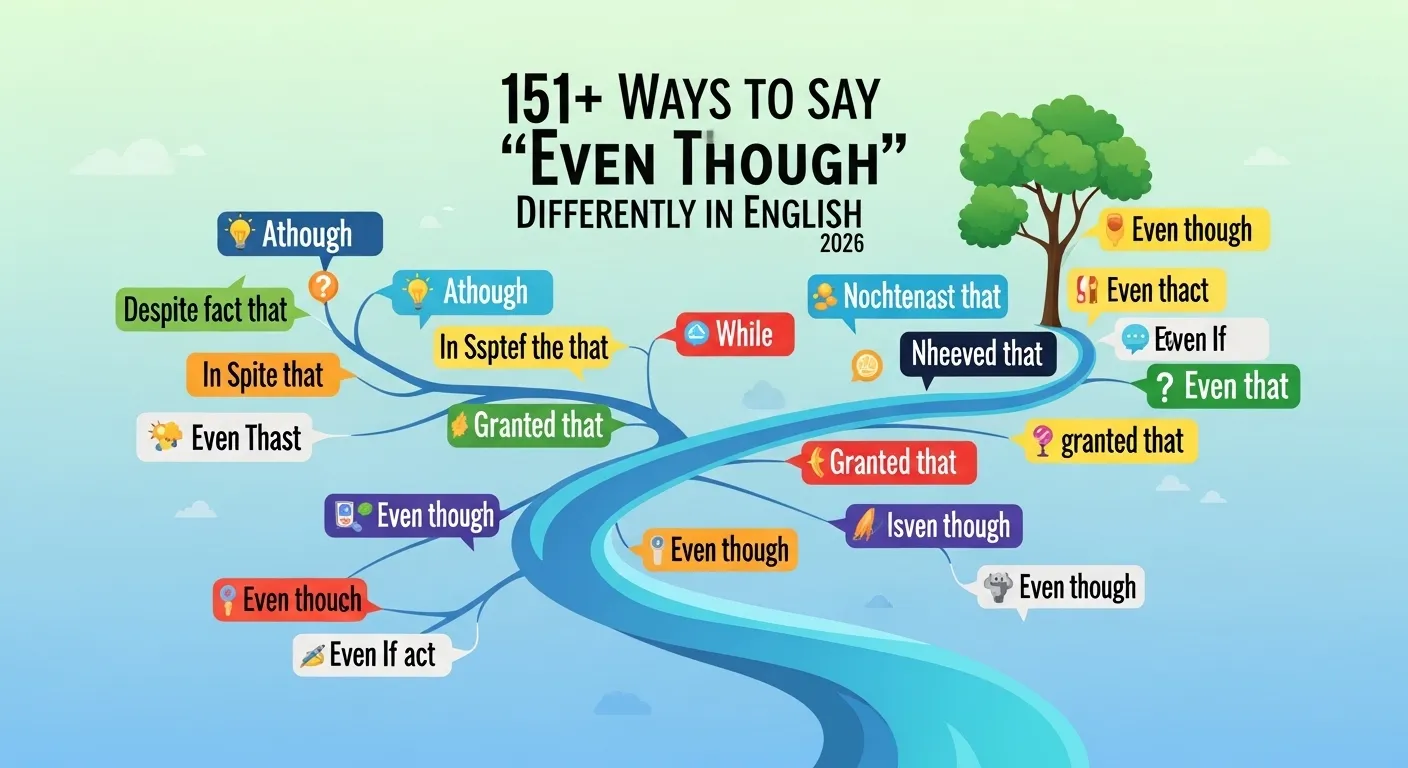
Another Way to Say Even Though: 102 Smooth Alternatives for Natural Writing in 2026
Concession is one of the most useful moves in English. It lets you admit one thing while insisting on another: even though it was raining, we kept playing. The problem is that writers lean on those two words until every paragraph sounds the same. Finding another way to say even though gives your sentences rhythm and variety, whether you are texting a friend, writing an essay, or polishing a business email.
This guide collects 80 alternatives organized by tone: casual conversation, formal writing, academic work, punchy one word swaps, and playful options for messages. You will also learn the subtle differences between lookalikes like although and though, the mistakes that make concession sentences confusing, and answers to the most asked grammar questions. Let us make your contrasts sharper.
What Even Though Really Does
Even though introduces a contrast between two true facts. The first fact would normally prevent the second, but the second happens anyway. Even though she was tired, she finished the race. Tiredness usually stops people, yet she finished. That surprise is the whole point of the construction.
The phrase is slightly stronger than although, because even adds emphasis to the surprise. Compare although it rained, we played with even though it poured, we played. The second version stresses that the obstacle was bigger. Keep this strength in mind when choosing alternatives: some are gentle, some are forceful, and matching the force to your meaning is what makes writing feel natural.
Casual Alternatives for Everyday Conversation
In speech and texts, concession should sound effortless. These casual alternatives fit chats, captions, and friendly emails.
- Although: Although it was late, we kept talking.
- Though: Though he was nervous, he nailed the speech.
- Even if: Even if it rains, we are going.
- Still: It was expensive. Still, we bought it.
- But still: The movie was long, but still worth it.
- And yet: She had every excuse, and yet she showed up.
- That said: The hotel was pricey. That said, the view was unreal.
- All the same: He was warned. All the same, he tried.
- For all that: For all that, she never complained.
- Be that as it may: Be that as it may, we have to decide today.
- Granted: Granted, it was risky, but it paid off.
- Sure, but: Sure, it costs more, but it lasts longer.
- Yeah, but still: Yeah, the line was long, but still fun.
- No matter what: No matter what, I am finishing this book.
- Whatever happens: Whatever happens, we tried our best.
Formal Alternatives for Professional Writing
Business and official writing needs concession language that sounds measured. These formal alternatives keep your tone polished.
- Although: Although costs rose, margins held steady.
- Notwithstanding: Notwithstanding the delay, delivery completed on time.
- Despite the fact that: Despite the fact that funding fell, the program expanded.
- In spite of the fact that: In spite of the fact that demand dropped, hiring continued.
- While: While the results disappointed, the method was sound.
- Whereas: Whereas the old system lagged, the new one responds instantly.
- Nevertheless: The market turned. Nevertheless, we stayed invested.
- Nonetheless: He lacked experience. Nonetheless, he delivered.
- Regardless: Regardless of the outcome, the effort mattered.
- Albeit: She agreed, albeit reluctantly.
- Much as: Much as we wanted to wait, the deadline forced our hand.
- Granted that: Granted that risks exist, the benefits outweigh them.
Academic and Analytical Alternatives
Research writing often concedes a limitation before stating a finding. These academic alternatives handle that move gracefully.
- Although: Although the sample was small, the trend was clear.
- Despite: Despite earlier doubts, the hypothesis held.
- Notwithstanding: Notwithstanding these limits, the data support the claim.
- While: While prior studies disagree, our results align with recent work.
- Even so: The method was costly. Even so, it proved reliable.
- Admittedly: Admittedly, the evidence is indirect, yet it is consistent.
- To be sure: To be sure, more trials are needed, but the signal is strong.
- It is true that: It is true that exceptions exist. The pattern still dominates.
- Granted: Granted, the design was simple, which aided replication.
- For all: For all its flaws, the model predicts well.
Short and Punchy One Word Swaps
Sometimes you just need a single word. These one word alternatives are perfect for tight sentences, headlines, and dialogue.
- Though: Rich, though unhappy.
- Yet: Small yet mighty.
- Still: Late, still welcome.
- Albeit: A win, albeit a narrow one.
- While: While tired, she smiled.
- Despite: Despite everything, they laughed.
- Regardless: Regardless, we move forward.
- Anyway: It failed. Anyway, we learned.
- Anyhow: Anyhow, the show went on.
- Nevertheless: Nevertheless, she persisted.
A style note: though can also sit at the end of a sentence, which although cannot do. The plan worked, though. That trailing though adds a conversational shrug that readers love in blogs and messages.
Playful Alternatives for Messages and Captions
Texts and social captions can concede with a wink. These playful alternatives keep the contrast fun.
- Plot twist: Plot twist: I hate mornings, yet here I am at sunrise yoga.
- But hey: The flight was delayed, but hey, free snacks.
- Go figure: Go figure, the cheapest option worked best.
- Funny enough: Funny enough, the mistake led to the idea.
- Believe it or not: Believe it or not, I finished before lunch.
- Against all odds: Against all odds, the plant survived my vacation.
- Somehow: Somehow, the group project actually worked.
- Oh well, still: Oh well, still the best weekend in months.
Common Mistakes With Concession Phrases
Doubling up the contrast. Even though it rained, but we played is wrong. The concession word already does the job of but, so using both creates a grammatical pileup. Pick one: Even though it rained, we played.
Confusing although with because. Some writers accidentally flip the meaning. Although she studied, she failed means studying did not prevent failure. Make sure the surprise direction matches your intent before you publish.
Using even though for simple contrast. Not every contrast needs concession. Even though he likes tea, she likes coffee sounds odd because neither fact surprises. Save even though for genuine tension between the clauses, and use while or whereas for neutral comparisons.
Repeating the same opener. Paragraphs that all begin with although or even though feel monotonous. Rotate through this list, and sometimes move the concession to the middle or end of the sentence for rhythm.
Forgetting the comma. When the concession clause comes first, it needs a comma: Even though it was late, we stayed. When it comes second, no comma is needed: We stayed even though it was late. Small mark, big difference in readability.
This guide collects 102 alternatives organized by tone: casual conversation, formal writing, academic work, punchy one word swaps, and playful options for messages. You will also get a plain comparison of lookalikes like although, though, and even though, the comma rules that trip people up, the mistakes that make concession sentences confusing, and answers to the most asked grammar questions.
Quick Pick: Use though in conversation, although in emails and essays, while in business writing, notwithstanding in formal documents, and but still in texts. For punchy one word contrast, try yet or nevertheless.
- Although. Example: Although it was late, we kept talking.
- Though. Example: Though he was nervous, he nailed the speech.
- Even if. Example: Even if it rains, we are going.
- Still. Example: It was expensive. Still, we bought it.
- But still. Example: The movie was long, but still worth it.
- And yet. Example: She had every excuse, and yet she showed up.
- That said. Example: The hotel was pricey. That said, the view was unreal.
- All the same. Example: He was warned. All the same, he tried.
- Granted. Example: Granted, it was risky, but it paid off.
- Sure, but. Example: Sure, it costs more, but it lasts longer.
- For all that. Example: For all that, she never complained.
- No matter what. Example: No matter what, I am finishing this book.
- Notwithstanding. Example: Notwithstanding the delay, delivery completed on time.
- Despite the fact that. Example: Despite the fact that funding fell, the program expanded.
- In spite of the fact that. Example: In spite of the fact that demand dropped, hiring continued.
- While. Example: While the results disappointed, the method was sound.
- Whereas. Example: Whereas the old system lagged, the new one responds instantly.
- Nevertheless. Example: The market turned. Nevertheless, we stayed invested.
- Nonetheless. Example: He lacked experience. Nonetheless, he delivered.
- Regardless. Example: Regardless of the outcome, the effort mattered.
- Much as. Example: Much as we wanted to wait, the deadline forced our hand.
- Be that as it may. Example: Be that as it may, we have to decide today.
- Although. Example: Although the sample was small, the trend was clear.
- Despite. Example: Despite earlier doubts, the hypothesis held.
- Even so. Example: The method was costly. Even so, it proved reliable.
- Admittedly. Example: Admittedly, the evidence is indirect, yet it is consistent.
- To be sure. Example: To be sure, more trials are needed, but the signal is strong.
- It is true that. Example: It is true that exceptions exist. The pattern still dominates.
- For all. Example: For all its flaws, the model predicts well.
- Albeit. Example: She agreed, albeit reluctantly.
- While. Example: While prior studies disagree, our results align with recent work.
- Albeit. Example: A win, albeit a narrow one.
- While. Example: While tired, she smiled.
- Despite. Example: Despite everything, they laughed.
- Anyway. Example: It failed. Anyway, we learned.
- Nevertheless. Example: Nevertheless, she persisted.
- However. Example: The data was thin. However, the argument convinced the panel.
- Plot twist. Example: Plot twist: I hate mornings, yet here I am at sunrise yoga.
- But hey. Example: The flight was delayed, but hey, free snacks.
- Go figure. Example: Go figure, the cheapest option worked best.
- Funny enough. Example: Funny enough, the mistake led to the idea.
- Believe it or not. Example: Believe it or not, I finished before lunch.
- Against all odds. Example: Against all odds, the plant survived my vacation.
- Somehow. Example: Somehow, the group project actually worked.
- Oh well, still. Example: Oh well, still the best weekend in months.
- Come what may. Example: Come what may, we are shipping on Friday.
- In any case. Example: In any case, we learned something useful.
Although vs Though vs Even Though
These three cause the most confusion, so here is the plain difference. Although is the neutral, slightly formal one. Use it in essays, emails, and reports. Though is the casual cousin. Use it in conversation, and remember it is the only one that can end a sentence. Even though is the strongest. Use it when the contrast is surprising or dramatic.
Also watch the grammar shape. Although, though, and even though all start a dependent clause attached to a main clause. Words like nevertheless, however, and nonetheless are different: they link two independent clauses and need a semicolon or a full stop before them. Albeit introduces only a short qualifying phrase, never a full clause, and it cannot start a sentence.
Comma Rules You Should Know
When the concession clause comes first, it needs a comma: Even though it was late, we stayed. When it comes second, no comma is needed: We stayed even though it was late. Small mark, big difference in readability.
With nevertheless and however joining two sentences, punctuate like this: The data was thin; however, the argument convinced the panel. And when though trails at the end, add a comma before it: The plan worked, though.
Forgetting the comma. Openers need a comma after the clause. Even though it was late, we stayed. This is the most common mechanical error in concession sentences.
What is the difference between although and even though?
Can though replace even though everywhere?
Is it okay to start a sentence with even though?
What is a formal alternative to even though?
How do I vary concession sentences in an essay?
Can I use albeit at the start of a sentence?
No. Albeit appears in the middle of a sentence and introduces a short qualifying phrase, like an adjective or a prepositional phrase. For sentence openers, use although or even though instead.
Concession is a power move, but only when the words stay fresh. With 50 alternatives across five tones, plus the comma rules and comparison guidance, you can now admit the obstacle and deliver your point without ever sounding repetitive. Casual chats get though and but still. Formal reports get notwithstanding and although. Messages get plot twist and go figure.
Even Though Alternatives for Compliments
Compliments with concession feel deeper. Although the task was tough, you made it look easy praises skill. Despite the short notice, your work was flawless honors effort. Even with little sleep, you brought great energy is warm and real.
Best use: pair a concession with praise to make the compliment land harder. The obstacle makes the praise believable, while praise alone can feel generic.
How to Concede a Point and Still Win the Argument
Conceding wisely builds credibility. You are right about the cost, and that is why the timeline matters more yields a point to win the frame. Granted, the old method was faster, but the new one is safer is honest and strategic. Even so, the evidence still favors waiting holds ground politely.
Best use: concede the small point loudly, then restate your main claim. Audiences trust speakers who admit a point, and they follow the argument that survives the admission.
Even Though Alternatives for Sports, Games, and Friendly Rivalry
Sports and games are full of surprises, and concession phrases make those surprises fun to tell. A line like despite the rain or although we were tired turns a plain result into a small story of effort and heart. The best sports writing pairs the setback with the outcome in one breath, so the reader feels both the struggle and the win. Keep the phrase short and the energy high, because a long concession slows a fast game down.
- Despite the rain, our team played its best match of the season.
- Although we were two goals down, nobody on the bench stopped believing.
- Even with a sore ankle, she finished the race and smiled at the line.
- While the other team was taller, our passing was quicker and sharper.
- Granted, the referee made a tough call, but we kept our heads and won.
- For all the noise from the crowd, our captain stayed calm and led us home.
Even Though Alternatives for Cooking, Crafts, and Hobbies
Cooking, crafts, and hobbies are full of happy accidents, and concession phrases help you tell those stories with charm. A line like although the cake sank or despite the tangled yarn admits the flaw while celebrating the result, which is exactly how real makers talk. The tone should stay warm and honest, because readers trust a maker who shares the mess as well as the magic. A small concession makes the success taste sweeter.
- Although the cake sank in the middle, it tasted wonderful with warm cream.
- Despite the tangled yarn, the scarf turned out soft and full of color.
- Even with only half the spices, the curry filled the whole house with scent.
- While the paint dried unevenly, the picture still made my mother smile.
- Granted, my first loaf was heavy, but the second rose beautifully.
- For all my shaky hands, the handmade card came out lovely and personal.
More Questions Readers Ask
How do I use even though in a sports story? Pair the setback with the outcome in one breath, like despite the rain, our team played its best match, so the reader feels the struggle and the win.
What concession phrase fits a cooking story? Use although the cake sank or despite the tangled yarn, because admitting the flaw while celebrating the result is how real makers talk.
Is granted too formal for casual writing? No, granted works well in casual stories too, as long as the sentence stays short and the tone stays warm and honest.
Frequently Asked Questions
What is the difference between although and even though
Both introduce contrast, but even though is stronger and more emphatic. Use although for mild, expected contrasts and even though when the obstacle feels surprising or dramatic. In formal writing, although is slightly more common at the start of sentences.
Can though replace even though everywhere
Almost. Though is the casual cousin of although and works in most of the same spots. It also has a bonus trick: it can end a sentence, as in It worked, though. In very formal documents, prefer although over though.
Is it okay to start a sentence with even though
Yes, completely. Even though the data was messy, the conclusion was clear. Just remember the comma after the opening clause. Starting with the concession is actually a strong stylistic choice because it builds suspense before the main point lands.
What is a formal alternative to even though
Notwithstanding, despite the fact that, and in spite of the fact that are the most formal options. For business writing, although and while usually strike the right balance between polish and readability.
How do I vary concession sentences in an essay
Rotate three techniques: change the word (although, despite, while), change the position (start, middle, or end of the sentence), and occasionally drop the conjunction entirely with a two sentence pattern like The evidence was thin. Even so, the argument convinced the panel. Variety in all three dimensions keeps academic prose lively.
How to Choose the Right Alternative
Start with the setting. The best replacement for even though in a formal email is rarely the best one in a quick text, so decide where the line will be read before you decide which line to send.
Next, match the tone to your relationship with the reader. People you know well can handle playful and informal wording, while new contacts, managers, and clients usually respond better to steady and polite wording.
Finally, check the meaning. Say the alternative out loud in the full sentence. If it keeps the sense of even though, sounds natural, and needs no explanation, it is the right choice. If you have to explain it, pick a simpler one.
Even Though Alternatives for Apologies and Explanations
Apologies need concession without excuses. Admit the obstacle honestly, then state what you did anyway, so the reader hears responsibility rather than blame shifting.
- Although the delay was ours, we finished the work the same week.
- Despite the short notice, the team delivered a clean result.
- Even so, we take full responsibility for the confusion.
- Granted, the timing was poor, and we have fixed the process.
- Still, your patience mattered, and we appreciate it.
Keep apology concessions short and direct. One admitted obstacle plus one clear action reads as honest, while a long defense reads as avoidance.
How to Move Concession to the Middle of a Sentence
Moving concession to the middle breaks the habit of starting every sentence the same way. Place the main point first, add the concession as a short aside, and finish with the result, so the sentence gains rhythm without losing clarity.
- Main point first, concession second, result last.
- Use though at the end for a light conversational touch.
- Use albeit for a short qualifying phrase only.
- Keep the middle concession brief, or the sentence will sag.
- Read the sentence aloud to check the natural pause.
Middle placement works best once or twice per paragraph. Used sparingly, it makes a familiar contrast feel fresh again.
Conclusion
Concession is a power move, but only when the words stay fresh. With 80 alternatives across five tones, you can now admit the obstacle and deliver your point without ever sounding repetitive. Casual chats get though and but still. Formal reports get notwithstanding and although. Messages get plot twist and go figure.
Take your next draft and highlight every even though. Replace each with the alternative that matches its sentence’s mood. Your contrasts will feel sharper, your rhythm will improve, and your readers will stay with you through every twist.