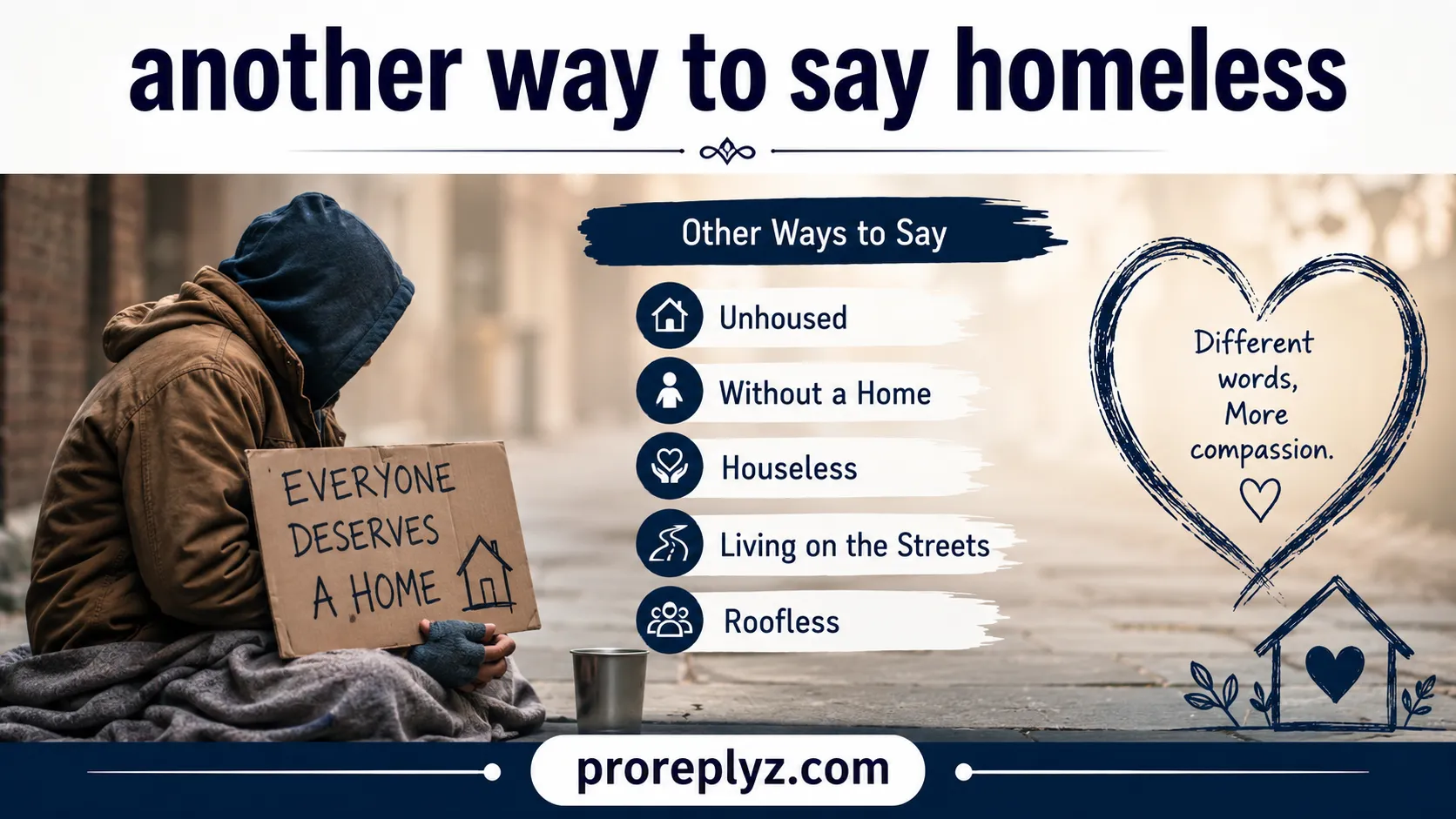
I still remember the day I first came across the phrase homeless in a conversation, and I felt unsure about how to respond or explain it better. I was trying to write something more respectful and meaningful, but I kept thinking there must be another way to say it.
That’s when I started exploring different expressions and learned how language can be more thoughtful and human centered.
Instead of sounding harsh, I wanted my words to feel softer and more understanding. I handled this issue by researching and comparing phrases until I found better alternatives that fit different contexts.
Now I can confidently say there are many polite and sensitive ways to express the idea. This small change in my wording made a big difference in how I communicate with others.
Let,s dive in!
Basic respectful terms

- Unhoused person
- Homeless person
- Person without a home
- Person without housing
- Person living without shelter
- Person experiencing homelessness
- Shelterless individual
- Roofless person
- Person without stable housing
- Person in need of housing
- Person in temporary living conditions
- Person between homes
- Person without permanent residence
- Person lacking housing
- Person living outdoors
- Person without fixed address
- Person in housing transition
- Person without secure housing
- Person in unstable housing situation
- Person without a residence
Housing insecurity focused
- Housing insecure person
- Housing unstable individual
- Person facing housing insecurity
- Person at risk of homelessness
- Person with unstable housing
- Person in housing crisis
- Person with limited housing options
- Person struggling with housing
- Person with inadequate housing
- Person with uncertain housing
- Person in housing hardship
- Person without secure shelter
- Person in housing distress
- Person lacking stable shelter
- Person with fragile housing situation
- Person in housing instability
- Person affected by housing issues
- Person in temporary housing struggle
- Person with housing challenges
- Person without safe housing
Temporary living situations

- Person in temporary shelter
- Person staying in emergency housing
- Person in transitional housing
- Person in short term accommodation
- Person staying in a shelter
- Person in temporary lodging
- Person in emergency accommodation
- Person in short stay housing
- Person between accommodations
- Person in temporary living space
- Person in crisis housing
- Person using support housing
- Person in interim housing
- Person in transitional shelter
- Person in temporary residence
- Person in backup housing
- Person in support shelter system
- Person in emergency stay housing
- Person in short term shelter
- Person in provisional housing
No permanent residence
- Person without permanent home
- Person without permanent shelter
- Person with no fixed residence
- Person without fixed home
- Person without permanent address
- Person lacking permanent shelter
- Person without long term housing
- Person without stable residence
- Person without lasting home
- Person without established housing
- Person without steady residence
- Person without durable shelter
- Person without consistent housing
- Person without ongoing residence
- Person without long term shelter
- Person without tled home
- Person without fixed dwelling
- Person without stable dwelling
- Person without regular residence
- Person without permanent dwelling
Living outdoors or exposed

- Person living outdoors
- Person sleeping outside
- Person living on the streets
- Person staying outside
- Person without indoor shelter
- Person exposed to elements
- Person living in public spaces
- Person resting in open areas
- Person staying in open spaces
- Person sleeping in public
- Person without indoor housing
- Person living in outdoor conditions
- Person staying under the sky
- Person without covered shelter
- Person living rough outdoors
- Person in street living conditions
- Person staying in open environment
- Person living without cover
- Person sleeping in open air
- Person surviving outdoors
Support system and services
- Person using shelter services
- Person receiving housing support
- Person in support program housing
- Person accessing emergency shelter
- Person in social housing support
- Person using outreach services
- Person in assisted housing program
- Person in housing assistance system
- Person receiving housing aid
- Person supported by shelter programs
- Person in rehabilitation housing
- Person in care housing program
- Person in community housing support
- Person in temporary aid housing
- Person in transitional support services
- Person receiving accommodation help
- Person in emergency support housing
- Person in housing recovery program
- Person in assistance shelter system
- Person supported by housing services
Crisis and hardship terms
- Person in housing crisis situation
- Person in severe housing hardship
- Person affected by shelter crisis
- Person in survival housing mode
- Person in emergency living condition
- Person facing shelter shortage
- Person in critical housing need
- Person in urgent housing need
- Person in extreme housing difficulty
- Person in unstable living crisis
- Person in acute housing distress
- Person in survival shelter situation
- Person in difficult housing condition
- Person in housing emergency
- Person in unstable shelter crisis
- Person in hardship housing state
- Person in fragile living condition
- Person in housing instability crisis
- Person in urgent shelter need
- Person in critical shelter condition
Neutral descriptive phrasing
- Person without a dwelling
- Person without housing access
- Person without accommodation
- Person without lodging
- Person without shelter access
- Person without housing security
- Person without residential stability
- Person without home base
- Person without living quarters
- Person without housing support
- Person without safe dwelling
- Person without housing stability
- Person without private residence
- Person without living space
- Person without secure dwelling
- Person without housing foundation
- Person without stable living place
- Person without residence security
- Person without housing provision
- Person without shelter stability
Everyday simple phrases
- Person with no home
- Person with no shelter
- Person with no place to stay
- Person without a place to live
- Person without a home base
- Person with nowhere to live
- Person with no fixed place
- Person with no housing
- Person with no roof over head
- Person without a stable place
- Person with no safe place
- Person without a regular home
- Person with no permanent place
- Person without a steady home
- Person with no living place
- Person without a secure home
- Person with no housing place
- Person without a safe shelter
- Person with no residence place
- Person without a living base
Formal and policy style terms
- Individual experiencing homelessness
- Person in housing deprivation
- Person in residential insecurity
- Person in shelter deprivation
- Person in housing exclusion
- Person in housing marginalization
- Person affected by homelessness
- Person in housing displacement
- Person in residential displacement
- Person in housing instability condition
- Person in shelter exclusion
- Person in housing vulnerability
- Person in accommodation insecurity
- Person in residence instability
- Person in housing access issues
- Person in shelter access issues
- Person in housing disadvantage
- Person in residential disadvantage
- Person in housing access deprivation
- Person in accommodation deprivation
Compassionate framing
- Person in need of stable home
- Person seeking safe housing
- Person needing shelter support
- Person rebuilding housing stability
- Person in search of home
- Person working toward housing security
- Person in housing recovery journey
- Person seeking permanent shelter
- Person needing housing assistance
- Person rebuilding residence stability
- Person in transition toward housing
- Person seeking safe residence
- Person working on housing solution
- Person moving toward stable home
- Person in path to housing security
- Person seeking steady shelter
- Person rebuilding living stability
- Person in journey to permanent housing
- Person needing stable residence
- Person moving toward secure housing
Language shapes how we see people. The word homeless is widely used, but when it becomes a label for a whole person, it hides everything else about them. Respectful language puts the person first and treats housing as a situation, not an identity. That small shift builds dignity into every sentence you write or speak.
This guide gives you 265 respectful ways to say homeless, sorted by context, with a real example sentence for each one. You will also learn why person first language matters, which words to avoid, and how to choose the right phrase for everyday talk, professional writing, and policy work.
Why Person First Language Matters
Person first language places the person before the condition. Saying a person experiencing homelessness instead of a homeless person reminds the reader that housing is one part of a life, not the whole story. The person may be a parent, a veteran, a student, a neighbor, or a coworker. Their housing situation is real and serious, but it is not their identity.
This style also keeps your writing accurate. Housing situations change. People move into shelters, stay with family, find temporary rooms, or return to stable housing. A phrase that describes a situation stays true as the situation changes, while a label can stick unfairly. Writers, teachers, reporters, and aid workers all benefit from this precision.
Person First Everyday Terms
Use these phrases in everyday conversation, community writing, and general articles.
- A person experiencing homelessness. She is a person experiencing homelessness, and she volunteers at the food bank weekly.
- A person without a home. He is a person without a home, and he is asking for safe shelter tonight.
- A person without housing. The clinic serves any person without housing who needs care.
- A person without stable housing. A person without stable housing may move often between friends and shelters.
- A person without shelter. The outreach team looks for any person without shelter during cold nights.
- A person without a fixed address. A person without a fixed address can still register for support services.
- A person between homes. He is a person between homes, staying with relatives until his lease starts.
- A person in need of housing. The charity helps every person in need of housing in the district.
- A person without permanent residence. A person without permanent residence may still hold a steady job.
- A person living without shelter. A person living without shelter faces serious risks in winter weather.
- An unhoused person. The report counts each unhoused person with care and privacy.
- A person in housing transition. She is a person in housing transition, moving from a shelter to a flat.
- A person without secure housing. A person without secure housing may fear eviction at any time.
- A person in temporary living conditions. He is a person in temporary living conditions after losing his tenancy.
- A person without a residence. The form asks whether the applicant is a person without a residence.
Housing Insecurity and Support Terms
Use these phrases when you talk about services, support programs, or the causes behind housing loss.
- A person facing housing insecurity. A person facing housing insecurity may skip meals to pay rent.
- A person at risk of homelessness. Early help can protect a person at risk of homelessness.
- A person in housing crisis. The hotline takes calls from any person in housing crisis.
- A person with unstable housing. A person with unstable housing often struggles to keep a routine.
- A person struggling with housing. A person struggling with housing deserves patience, not judgment.
- A person in transitional housing. She is a person in transitional housing, building toward a permanent home.
- A person staying in emergency housing. He is a person staying in emergency housing while he finds work.
- A person in a shelter. A person in a shelter may still attend school and work daily.
- A person using shelter services. A person using shelter services should be treated with full privacy.
- A person receiving housing support. A person receiving housing support can now plan for the future.
- A person in a support program. She is a person in a support program that pairs housing with job coaching.
- A person in temporary shelter. A person in temporary shelter needs clear information about next steps.
- A person in short term accommodation. He is a person in short term accommodation while repairs finish.
- A person accessing emergency shelter. A person accessing emergency shelter should face no barriers at the door.
- A person in assisted housing. A person in assisted housing pays rent based on income.
Formal and Policy Terms
Use these phrases in reports, grant proposals, policy papers, and official documents.
- An individual experiencing homelessness. The study followed each individual experiencing homelessness for twelve months.
- A person in housing deprivation. A person in housing deprivation may lack heat, water, or privacy.
- A person in residential insecurity. The policy defines support for any person in residential insecurity.
- A person in shelter deprivation. A person in shelter deprivation faces greater health risks.
- A person affected by homelessness. The fund serves any person affected by homelessness in the region.
- A person in housing displacement. A person in housing displacement may have lost a home to rising rents.
- A person in housing instability. The survey measures how many live with housing instability each year.
- A person in housing vulnerability. A person in housing vulnerability needs early and steady support.
- A person in accommodation insecurity. The report tracks each person in accommodation insecurity across cities.
- A person in housing exclusion. A person in housing exclusion may be locked out of the rental market.
- A person in housing disadvantage. The program targets any person in housing disadvantage with extra help.
- A person in shelter exclusion. A person in shelter exclusion may be turned away from full shelters.
- A person in housing access issues. A person in housing access issues may lack documents or references.
- A person in residential displacement. A person in residential displacement may have left home after a disaster.
- A person in housing marginalization. The paper studies how housing marginalization affects health over time.
Words to Avoid and Why
Some old terms reduce a person to a stereotype. Avoid calling someone the homeless as a noun, because it turns a situation into an identity. Avoid bum, vagrant, tramp, and drifter, which are insulting and dismissive. Avoid bag lady, which mocks people, especially women, for carrying their belongings. If you catch yourself using one of these words, replace it with a person first phrase from this guide. The change costs nothing, and it protects the dignity of the person you describe.
Also avoid guessing at causes. Do not assume that every person without housing faces the same story. Job loss, illness, family breakdown, domestic abuse, disaster, and rising rents can each play a part. Respectful writing describes the situation in front of you and leaves the rest unsaid.
How to Choose the Right Phrase
For everyday talk, choose short and natural phrases like a person without a home or an unhoused person. For service and charity writing, choose phrases that name the support, such as a person receiving housing support or a person in transitional housing. For policy and research writing, choose precise formal terms like an individual experiencing homelessness. In every setting, keep the person first, keep the tone calm, and keep the focus on housing, not on labels.
Person First Phrases for News and Community Writing
News and community writing reaches many readers, so wording choices carry extra weight. A respectful sentence names the person first and describes housing as a situation. Say a person experiencing homelessness spoke at the meeting about bus routes and shelter hours. That sentence keeps the focus on the person and the issue, not on a label. Another careful choice is residents without stable housing, which suits stories about a neighbourhood or a housing program. Residents sounds like belonging, and stable housing names the need clearly.
When a story covers many people, avoid turning a group into a single label. Say people facing housing insecurity in the city, rather than reducing a varied group to one word. People facing housing insecurity includes families, workers, students, and older adults, and it leaves room for different stories. For service news, name the service as well. Say the new centre will welcome any person seeking shelter support tonight. A sentence like that informs readers and protects dignity at the same time.
Phrases for Talking About Housing Help Without Labels
Talking about help works best when the words focus on needs and solutions. Say a person looking for stable housing can ask the centre about rooms, meals, and job coaching. Looking for stable housing describes a goal, not an identity, and it points toward help. Another useful phrase is a person rebuilding housing stability, which suits stories about progress over time. Rebuilding suggests effort and hope, and it avoids pity.
When you write about donations or volunteering, keep the language practical. Say the charity supports people moving from temporary shelter into steady homes. Moving from temporary shelter into steady homes describes a journey with clear steps. Avoid guessing why someone lost housing, because causes differ widely. Describe only what you know, name the help available, and let the person remain a full person in every sentence you write.
Respectful Language for Talking About Homelessness
Language about homelessness should protect dignity first. People experiencing homelessness is the respectful standard, because it names a situation rather than defining a person by it. Neighbors without stable housing suits community discussions where local care is the focus. People facing housing insecurity fits policy and charity writing. These phrases matter because words shape how readers see real people, and respectful words lead to respectful responses.
Best use: use person first language in every context, from casual conversation to formal reports. Once respectful phrasing becomes habit, it costs nothing and dignifies everyone it describes.
How to Offer Help With Dignity
Offering help requires as much care as the help itself. Would a meal be useful today asks rather than assumes. I have some warm clothes if you would like them offers a choice, which preserves autonomy. Is there a local shelter or service I can connect you with respects the fact that the person knows their own needs best. The best offers are specific, optional, and free of conditions.
Best use: make one concrete offer and accept the answer gracefully, including a no. Dignity in helping means the person keeps control of the interaction, even when they accept the help.
Frequently Asked Questions
What is the most respectful way to say homeless?
A person experiencing homelessness is the most widely recommended phrase. It keeps the person first, describes a situation rather than an identity, and works in writing, speech, and professional reports.
Is unhoused a respectful term?
Yes. Unhoused person is widely used by housing advocates and reporters. It is shorter than person first phrases, and it still treats housing as a situation, not a character trait.
Should I say homeless person in formal writing?
It is better to avoid it. Formal writing should use a person experiencing homelessness or an individual experiencing homelessness. These phrases are clearer, kinder, and more precise about the situation.
Why is the homeless as a noun considered harmful?
Using the homeless as a noun groups many different people into one label. It erases jobs, families, and personal stories, and it makes a temporary situation sound permanent. Person first language avoids that trap.
How do I talk about homelessness with children?
Keep it simple and kind. Say some people do not have a safe home right now, and explain that helpers, shelters, and communities work to support them. Avoid scary details, and focus on empathy and help.
Words carry weight, and small changes in wording can change how people are seen. With these 45 respectful ways to say homeless, you can write and speak with accuracy, empathy, and dignity. Put the person first, describe the situation honestly, and let your language reflect the respect every person deserves.
Common Mistakes to Avoid
The most common mistake is using a formal alternative in a casual moment, or a casual one in a formal moment. A replacement for homeless that ignores the setting can sound cold, forced, or careless, even when the words themselves are fine.
A second mistake is overloading the sentence. One strong alternative carries the message. Stacking two or three alternatives together makes the line sound rehearsed and weakens the point you wanted to make.
A third mistake is copying a line without adjusting it. Change one small detail, such as the name, the time, or the reason, so the alternative fits the actual moment instead of sounding pasted in.
Using These Alternatives in Emails and Short Messages
In an email, place the alternative early, ideally in the first two lines, and follow it with the one detail that matters: a date, a name, or a clear next step. Early placement is what makes a replacement for homeless sound confident instead of decorative.
In a short message, keep the alternative short and send it on its own line where you can. Short messages reward warmth and speed, so one clean line with a personal detail will almost always beat a long, polished paragraph.
Why is person first language preferred in this topic?
Person first language puts the person before the housing situation. It treats housing as a changeable situation, not as an identity, and it keeps dignity at the centre.
Is unhoused always a respectful choice?
Unhoused is widely used and shorter than longer phrases. Use it when brevity matters, and use a person first phrase when you want the clearest, warmest wording.
How do I write respectfully about a shelter visit?
Describe what you saw and what help is offered, without guessing personal stories. Name services, quote people only with permission, and keep the tone calm.
What should I say when I do not know someone’s situation?
Stay general and kind. Say a person without stable housing, and avoid assuming causes, history, or needs. General wording protects privacy and prevents unfair labels.
Conclusion:
In conclusion, there are many respectful and varied ways to say homeless, such as unhoused, without stable housing, housing insecure, or people experiencing homelessness.
Each term shifts focus from identity to situation, emphasizing dignity and circumstances rather than labels. Choosing careful language helps reduce stigma and encourages empathy in communication.
Using more human-centered expressions supports awareness, understanding, and better conversations about housing challenges in society today.