I remember the moment clearly I was writing something important, trying to sound confident and fluent, but I kept repeating the same word again and again: which. It started to feel awkward, almost like my sentences were losing their impact.
Have you ever felt that too? Like you know what you want to say, but the words just don’t sound right?
That’s exactly where I got stuck. I paused, reread my work, and realized I needed another way to say “which” to make my writing smoother and more natural.
So I started exploring simple alternatives, testing them in my sentences, and slowly, everything began to flow better.
What surprised me was how such a small change made a big difference. My writing sounded more confident, more polished and honestly, I felt more confident too.
So if you’re facing the same issue right now, don’t worry. I’ve been there. And the good news? It’s much easier to fix than you think. Let me show you how.
1. Choices in Questions
- what one
- what item
- what thing
- what option
- what alternative
- what selection
- what pick
- what kind
- what sort
- what type
- what variation
- what category
- what version
- what edition
- what model
- what example
- what specimen
- what instance
- what sample
- what option best
2. Clarifying in Sentences
- that one
- that item
- that thing
- that option
- that alternative
- that choice
- that selection
- that kind
- that type
- that variety
- that version
- that model
- that example
- that instance
- that example best
- that particular one
- that specific thing
- that certain option
- that exact type
- that single choice
3. Informal Everyday Alternatives
- which one
- which item
- which thing
- which choice
- which option
- which pick
- which kind
- which sort
- which type
- which variety
- which example
- which model
- which version
- which sample
- which instance
- which alternative
- which selection
- which particular
- which certain
- which exact
4. Written English Variations
- the one that
- the item that
- the thing that
- the option that
- the alternative that
- the selection that
- the choice that
- the type that
- the kind that
- the sort that
- the version that
- the model that
- the example that
- the sample that
- the instance that
- the specific one that
- the particular one that
- the certain one that
- the exact one that
- the single one that
5. Academic or Formal Style
- which particular
- which specific
- which exact
- which precise
- which distinct
- which respective
- which indicated
- which noted
- which mentioned
- which referred
- which designated
- which identified
- which recognized
- which highlighted
- which cited
- which specified
- which acknowledged
- which observed
- which demonstrated
- which described
6. Conversational English Alternatives
- the one you mean
- the one I mean
- the one we choose
- the one they picked
- the one she wants
- the one he likes
- the one it is
- the one in mind
- the one over there
- the one here
- the one now
- the one later
- the one first
- the one next
- the one before
- the one after
- the one again
- the one always
- the one never
- the one maybe
7. Short and Simple Words
- what
- that
- this
- these
- those
- any
- each
- every
- some
- one
- some one
- other
- another
- either
- neither
- few
- many
- several
- all
- none
8. Pronouns and References
- whichever
- whatever
- whomever
- whichever one
- whatever one
- whomever one
- any that
- any which
- each one
- each that
- every one
- every that
- those which
- this which
- that which
- the one which
- the ones which
- one which
- ones which
- all which
9. In Context of Selection
- pick that
- pick this
- choose one
- choose that
- select one
- select that
- grab that
- grab this
- take one
- take this
- go for that
- go for this
- opt for that
- opt for this
- prefer that
- prefer this
- decide on that
- decide on this
- go with that
- go with this
10. Alternatives in Writing Clarity
- aforementioned
- aforementioned item
- aforementioned choice
- aforementioned option
- aforementioned type
- aforementioned example
- mentioned
- mentioned item
- mentioned choice
- mentioned option
- referenced
- referenced item
- referenced choice
- referenced option
- designated
- designated item
- designated choice
- designated option
- noted
- noted item
11. Miscellaneous Practical Options
- the right one
- the best one
- the proper one
- the suitable one
- the ideal one
- the preferred one
- the chosen one
- the correct one
- the selected one
- the final one
- the main one
- the important one
- the necessary one
- the key one
- the relevant one
- the applicable one
- the fitting one
- the recommended one
- the favored one
- the intended one
Repeating the word which in every sentence makes writing feel stiff and repetitive. Readers notice the pattern, and the sentences start to blur together. The good news is that English offers many smooth ways to ask about choices, point to a specific thing, or connect a clause without leaning on which again and again. Once you know the options, your writing sounds more natural, more confident, and easier to follow.
This guide gives you more than 40 replacements for which, organized by situation. You will find options for questions, clarifying sentences, formal writing, academic essays, and casual conversation. Each group includes examples so you can see exactly how the replacement works. By the end, you will know how to vary your wording without changing your meaning.
Why Writers Overuse Which
Which is a useful word. It asks about a choice, introduces a clause, and points to one item among many. Because it does so much work, writers reach for it automatically. The problem begins when it appears in nearly every sentence. Repetition drains the energy from your writing and can confuse readers when several clauses pile up.
Consider this sentence: “Which option is the one which you prefer, and which features matter most?” It is clumsy and hard to follow. A cleaner version reads: “What option do you prefer, and what features matter most?” One small swap improves rhythm and clarity. The goal is not to ban which from your vocabulary. The goal is to use it with intention and to choose a better word when a better word exists.
There is also a grammar point worth knowing. Which often introduces a nonessential clause, the kind set off by commas, while that often introduces an essential clause, the kind with no commas. For example: “The report, which I finished yesterday, is on your desk.” The clause adds extra detail. Compare that with: “The report that I finished yesterday is on your desk.” Here the clause identifies the report. Knowing this difference helps you choose the right replacement for each case.
Another Way to Say Which in Questions
When you ask about a choice, what is often the simplest replacement. It sounds natural and direct, especially in speech.
- Instead of: “Which one do you want?” Say: “What one do you want?” or “What would you like?”
- Instead of: “Which color suits me?” Say: “What color suits me?”
- Instead of: “Which day works for you?” Say: “What day works for you?”
- Instead of: “Which of these is correct?” Say: “What option is correct?”
- Instead of: “Which restaurant should we try?” Say: “What restaurant should we try?”
When you want to be more specific, name the category. Use what kind, what type, what sort, what version, or what model. For example: “What type of laptop do you need?” sounds more precise than “Which laptop do you need?” Other useful question starters include what alternative, what selection, what option, and what preference. Each one narrows the question and helps the listener answer faster.
Another Way to Say Which When Clarifying a Choice
When you point to a specific item, that one and this one often replace which neatly. They work best when the item is visible or already mentioned.
- “I want that one on the shelf.”
- “Give me this one in blue.”
- “She chose that option from the list.”
- “Pick that particular one with the larger screen.”
- “He meant that specific item, not the other one.”
- “We will go with the first choice you suggested.”
- “I prefer the second option because it costs less.”
You can also restructure the sentence to remove the question word entirely. Instead of “Tell me which one you like,” write “Tell me your favorite.” Instead of “I am unsure which route to take,” write “I am unsure about the best route.” Restructuring often produces the cleanest result, because it removes the awkward clause instead of patching it.
Another Way to Say Which in Sentences and Clauses
Inside a sentence, which often introduces a description. The best replacement depends on whether the clause is essential or extra detail.
- Essential clause with that: “The book that I borrowed from you was excellent.”
- Essential clause with who: “She is the teacher who helped me improve my writing.”
- Extra detail with a new sentence: “The book was excellent. I borrowed it from you last week.”
- Extra detail with and: “The book was excellent, and I borrowed it from you last week.”
- Extra detail with a participle: “The report, completed yesterday, is ready for review.”
- Extra detail with a preposition: “The house with the red door belongs to my aunt.”
Participle phrases are a powerful tool. Instead of “The project, which was started in March, is now complete,” write “The project, started in March, is now complete.” The sentence becomes shorter and stronger. Prepositional phrases help too. Instead of “The box, which is on the table, holds the supplies,” write “The box on the table holds the supplies.”
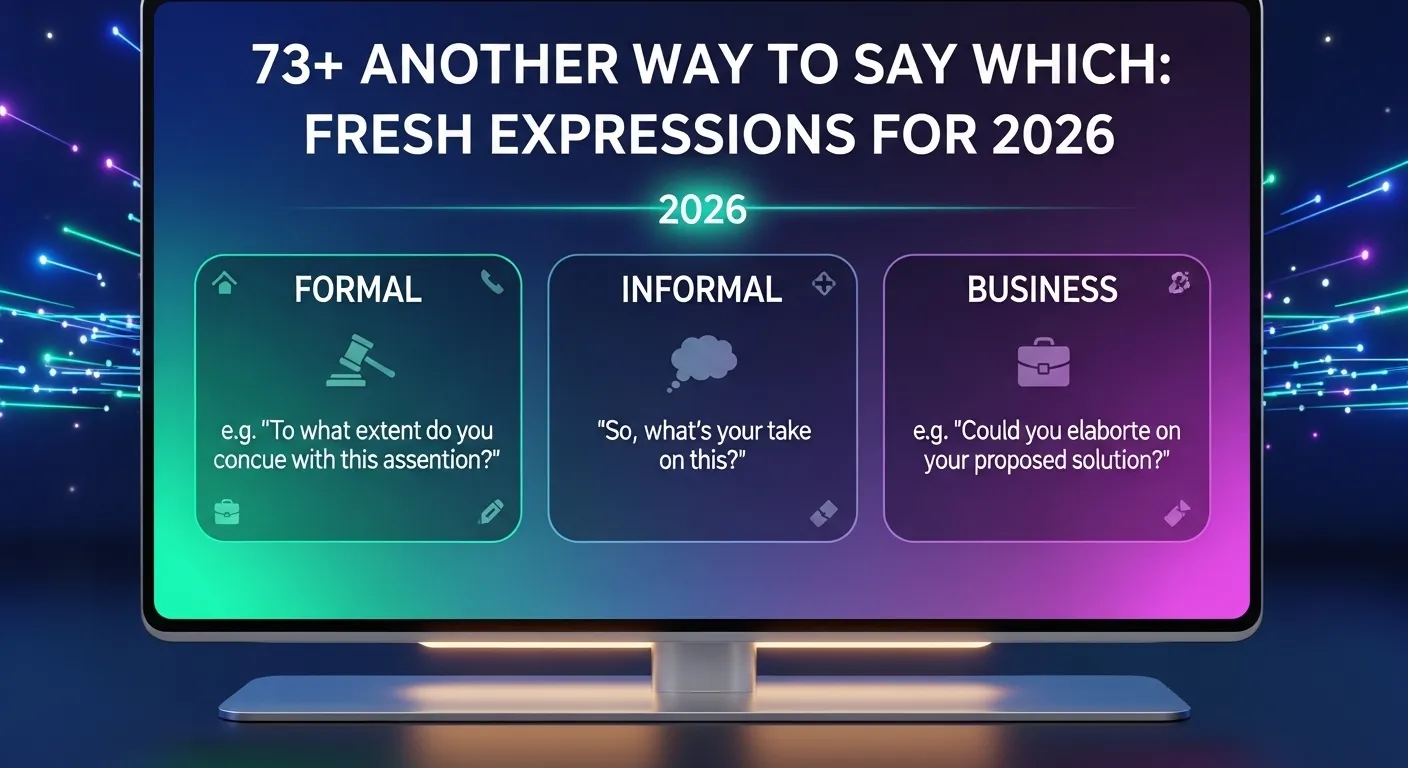
Formal and Academic Alternatives to Which
Academic and formal writing rewards precision. These replacements sound polished in essays, reports, and research papers.
- Which particular – Example: “The study examined which particular factors influence reading speed.”
- Which specific – Example: “The survey asked which specific features users value most.”
- Which exact – Example: “The report states which exact steps the team followed.”
- Which respective – Example: “Each manager reviewed which respective budget applied to her department.”
- The one that – Example: “Choose the one that best fits your budget.”
- The item that – Example: “Select the item that matches the description.”
- The option that – Example: “Pick the option that solves the problem with the least risk.”
- Whichever – Example: “Whichever route you choose, allow an extra hour for traffic.”
- Whatever – Example: “Whatever method you use, document each step.”
In academic writing, avoid stacking clauses. If a sentence contains which twice, split it. Two short sentences beat one tangled sentence every time. Your reader will thank you, and your argument will land with more force.
Casual and Conversational Alternatives
In everyday speech, people rarely say which in a formal way. They point, gesture, or use short phrases. These casual options sound natural in conversation, messages, and social posts.
- What one – Example: “What one are we watching tonight?”
- The one you mean – Example: “Is this the one you mean?”
- The one over there – Example: “Grab the one over there, near the window.”
- The one in mind – Example: “I had the one in mind with the blue cover.”
- Either one – Example: “Either one works for me.”
- Any of them – Example: “Any of them will do.”
- This or that – Example: “Do you want this or that?”
Notice how casual speech often drops the question word completely. “Coffee or tea?” works better than “Which beverage would you prefer?” in a friendly setting. Match your wording to your audience and your tone will always sound right.
How to Choose the Right Replacement
Follow this quick decision process whenever you catch yourself repeating which.
Step 1: Ask what job the word is doing
Is which asking a question, pointing to an item, or introducing a clause? The job determines the replacement. Questions usually take what. Pointing usually takes that one or this one. Clauses usually take that, who, or a restructured phrase.
Step 2: Check the formality of the setting
An essay needs which specific or the option that. A text message needs what one or this one. Matching formality keeps your tone consistent.
Step 3: Read the sentence aloud
If you stumble, the sentence needs restructuring. Splitting a long sentence into two short ones often removes the need for which entirely.
Step 4: Vary your choices
Do not replace every which with the same word. Rotating among what, that, this one, and restructured sentences keeps your writing lively and natural.
Common Mistakes With Which
- Using which for people. Use who for people. Write “the student who asked the question,” not “the student which asked the question.”
- Mixing which and that. Use commas with which for extra detail. Skip commas with that for essential detail. “The car, which is red, is mine” adds detail. “The car that is red is mine” identifies the car.
- Stacking clauses. Avoid sentences with two or three which clauses. Split them into shorter sentences.
- Leaving which dangling. Make sure the clause clearly connects to the noun it describes. Vague connections confuse readers.
- Repeating which in questions. Questions with which twice sound awkward. Replace the second one with what or restructure the question.
Practice Sentences: Before and After
- Before: “Which of the two plans, which we discussed yesterday, do you prefer?” After: “Of the two plans we discussed yesterday, what one do you prefer?”
- Before: “The jacket, which is on sale, is the one which I wanted.” After: “The jacket on sale is the one I wanted.”
- Before: “Tell me which book you borrowed and which chapter you finished.” After: “Tell me what book you borrowed and what chapter you finished.”
- Before: “Which route should we take, and which stops should we avoid?” After: “What route should we take, and what stops should we avoid?”
- Before: “The team, which won the award, is the team which trained hardest.” After: “The team that won the award is the team that trained hardest.”
Which Alternatives for Clearer Questions
Clear questions get clear answers, and which alternatives can sharpen them. Which option do you prefer is direct and polite. Out of these choices, which suits you best helps someone who feels stuck between options. Would you pick the first or the second narrows a wide question into a simple decision. These alternatives work because they reduce the work of answering, which makes people reply faster and more honestly.
Best use: use which alternatives when the choices are already known. When the choices are open, a what question works better, since which assumes a list the listener may not have.
Polite Ways to Ask Which One in Customer Service
Customer service questions should sound helpful, never pushy. Which version would you like me to send is efficient and kind. May I ask which size fits you best adds politeness without length. Which of these would solve the problem for you puts the customer need first, which is the right order in service language.
Best use: offer two clear options when asking which one, and confirm the choice back in your next line. Confirmation prevents the most common service error, which is acting on a guessed choice.
Which Alternatives for Shopping and Everyday Choices
Shopping questions work best when they name the detail you care about. These ask about size, price, and style naturally.
1. What size fits best. Meaning: the size that suits the person or room. Example: “What size fits best for a small kitchen table?” Best Use: clothes, shoes, and furniture shopping
2. What color do you like most. Meaning: a color preference asked directly. Example: “What color do you like most for the bedroom wall?” Best Use: paint, clothes, and home decor choices
3. What brand should I pick. Meaning: a brand recommendation asked for. Example: “What brand should I pick for a first laptop?” Best Use: tech shopping and gift buying
4. What style suits the room. Meaning: the look that fits the space. Example: “What style suits the room, modern or classic?” Best Use: interior design and furniture talks
5. What price range works. Meaning: a budget limit asked before choosing. Example: “What price range works for your birthday gift?” Best Use: shopping with a set budget
6. What model has the features. Meaning: the version that includes what you need. Example: “What model has the features we need for editing?” Best Use: phones, laptops, and appliances
7. What flavor do you want. Meaning: a taste preference asked simply. Example: “What flavor do you want for the birthday cake?” Best Use: food orders and party planning
8. What option costs less. Meaning: two choices compared by price. Example: “What option costs less, delivery or pickup?” Best Use: checkout choices and travel bookings
Which Alternatives for Work Decisions
Work decisions need questions that name the real choice. These help teams pick tools, plans, and people with clarity.
9. What approach should we take. Meaning: the team asked to choose a method. Example: “What approach should we take for the product launch?” Best Use: meetings and project planning
10. What tool fits the task. Meaning: the tool that suits the job. Example: “What tool fits the task, a spreadsheet or a database?” Best Use: office work and software choices
11. What vendor offers the best terms. Meaning: the supplier that gives the best deal. Example: “What vendor offers the best terms for bulk printing?” Best Use: procurement and supplier talks
12. What timeline makes sense. Meaning: a realistic schedule asked for. Example: “What timeline makes sense for the website rebuild?” Best Use: project plans and client updates
13. What priority comes first. Meaning: the team asked to rank the work. Example: “What priority comes first, speed or quality?” Best Use: sprint planning and task lists
14. What method saves the most time. Meaning: the fastest sound way to work. Example: “What method saves the most time on monthly reports?” Best Use: process reviews and team training
15. What plan reduces the risk. Meaning: the safest route forward. Example: “What plan reduces the risk of missing the deadline?” Best Use: risk talks and launch checklists
16. What candidate has the right skills. Meaning: the person who fits the role best. Example: “What candidate has the right skills for the support desk?” Best Use: hiring talks and interview notes
Frequently Asked Questions
What can I use instead of which in a question?
What is the simplest replacement in most questions. “What one do you want?” sounds natural and direct. For more precision, use what kind, what type, or what option to name the category you are asking about.
Can I replace which with that?
Yes, when the clause is essential to identify the noun. “The book that I borrowed was excellent” works well. When the clause adds extra detail, use a comma plus a restructured phrase instead, such as “The book, borrowed last week, was excellent.”
What is a formal alternative to which?
Formal options include which specific, which particular, the option that, and the item that. These sound polished in essays, reports, and professional documents.
How do I avoid repeating which in an essay?
Rotate your replacements. Use what in questions, that in essential clauses, participles for extra detail, and split long sentences into two short ones. Reading your draft aloud makes repetition easy to spot.
Is it wrong to use which for people?
Yes, in standard English you should use who or whom for people. Write “the teacher who helped me,” not “the teacher which helped me.” Using who shows correct grammar and sounds more natural.
Which is a handy word, but variety makes your writing stronger. Use what for questions, that one or this one for pointing, that or who for essential clauses, and restructured sentences whenever a clause feels tangled. Practice with the before and after examples, read your work aloud, and watch how quickly your sentences gain clarity. The next time you catch yourself repeating which, pause, pick a sharper replacement, and enjoy how much smoother your writing sounds.
When a Shorter Sentence Beats a Which Clause
A long which clause often hides the main point of your sentence. If you can split the idea into two short sentences, your reader will grasp it faster. For example, you can replace a tangled clause with a clean phrase, as in, “I need the report covering last quarter sales.”
Short sentences also help when you speak, because listeners cannot reread a tangled clause. Test your sentence aloud. If you run out of breath before the end, cut the which clause and start fresh with the detail in its own sentence.
- Read the sentence aloud and mark where you pause for breath.
- Keep only the detail that changes the meaning of the main point.
- Move extra detail to the next sentence instead of stacking it.
Matching Your Replacement to Your Reader’s Patience
A busy manager wants the point fast, while a careful reader may welcome a little extra detail. Choose a replacement that fits that patience level. For example, you can write, “Please send the file explaining the new pricing plan,” when detail matters, or simply, “Please send the pricing file,” when speed matters more.
When you are unsure, lean toward the shorter form. You can always add one clear detail later if the reader asks for it. A short first message earns attention, while a long first message often loses it.
- Picture one real reader before you pick a replacement phrase.
- Use the shortest clear form for busy readers and quick messages.
- Add one helpful detail only when it prevents a follow-up question.
Conclusion
In conclusion, the topic highlights the importance of thoughtful consideration and informed decision-making.
By examining different perspectives, we gain a clearer understanding of the subject and its broader implications. This awareness encourages more effective actions and responsible choices.
Ultimately, applying these insights can lead to improved outcomes, greater efficiency, and a deeper appreciation of the complexities involved in addressing real-world challenges.