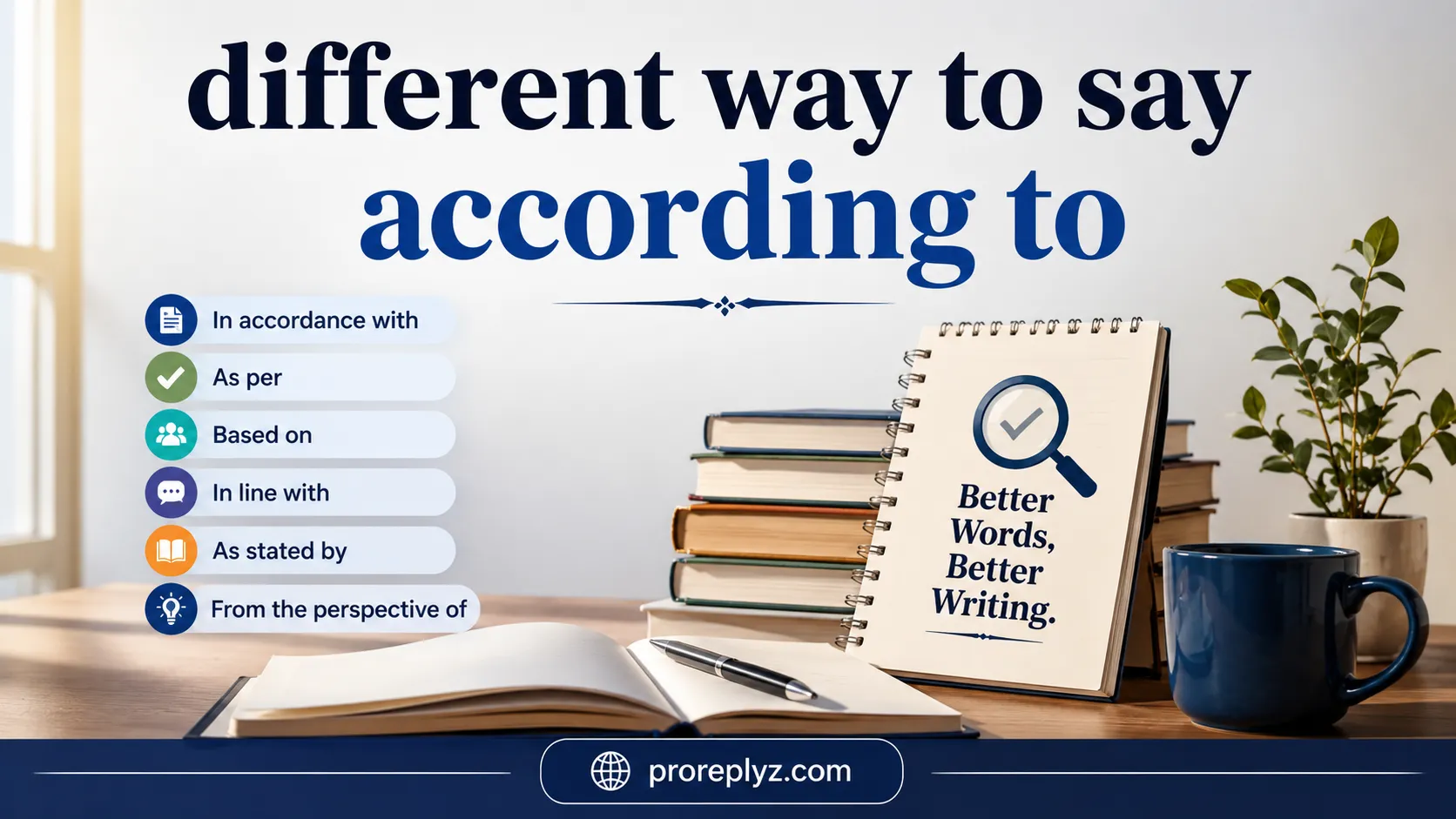
Have you ever found yourself using according to over and over while writing an email, blog post, or assignment? I certainly have.
A few months ago, I was working on an article and noticed that I had used the phrase several times in just a few paragraphs. The repetition made my writing feel dull and predictable.
That’s when I started looking for better alternatives. As I explored different expressions, I discovered that changing a simple phrase could make my writing sound more natural, professional, and engaging.
If you’ve run into the same problem, you’re not alone. In this guide, I’ll share some of the best different ways to say according to so you can add variety to your writing and communicate your ideas more effectively.
Let’s explore these useful alternatives together.
Formal Alternatives to According To

- As stated by
- As reported by
- As noted by
- As outlined by
- As indicated by
- As explained by
- As mentioned by
- As documented by
- As described by
- As observed by
- As cited by
- As recorded by
- As presented by
- As written by
- In accordance with
- In the opinion of
- As per
- On the authority of
- Following the views of
- In line with
Professional Ways to Say According To

- Based on
- In keeping with
- In agreement with
- Pursuant to
- In reference to
- In relation to
- In support of
- In harmony with
- Under the guidance of
- Guided by
- Drawing from
- In conformity with
- By the standards of
- Following
- As recommended by
- As advised by
- As suggested by
- In line with the views of
- Consistent with
- By reference to
Academic Alternatives to According To

- As argued by
- As proposed by
- As theorized by
- As researched by
- As concluded by
- As demonstrated by
- As discussed by
- As examined by
- As analyzed by
- As interpreted by
- As reviewed by
- As explored by
- As highlighted by
- As established by
- According to the findings of
- As evidenced by
- As illustrated by
- As summarized by
- As supported by
- As detailed by
Casual Ways to Say According To

- From what I heard
- From what I know
- Going by
- Based on what
- As someone says
- If you ask
- From their point of view
- By their account
- As they put it
- From their side
- By what they say
- In their words
- The way they see it
- From what they told me
- As they describe it
- From their experience
- As they explain
- If their story is right
- By their version
- According to them
Alternatives for News and Reports
- Sources say
- Reports suggest
- Officials say
- Experts believe
- Research shows
- Data indicates
- Surveys reveal
- Findings suggest
- Records show
- Statistics reveal
- Analysts say
- Witnesses report
- Documents reveal
- Investigations show
- News outlets report
- Authorities state
- Industry reports show
- Studies indicate
- Evidence suggests
- Recent reports reveal
Business Alternatives to According To
- As shared by
- As communicated by
- As confirmed by
- As updated by
- As announced by
- As instructed by
- As approved by
- As requested by
- As directed by
- As provided by
- As specified by
- As agreed by
- As verified by
- As clarified by
- As issued by
- As recommended internally
- As outlined in policy
- As noted in the report
- As highlighted by management
- In line with company guidance
Creative Ways to Say According To
- In the words of
- Through the eyes of
- By the account of
- As told by
- From the perspective of
- By the telling of
- Seen through
- Through the lens of
- Echoing the views of
- Following the wisdom of
- Inspired by
- As echoed by
- By the voice of
- As reflected in
- In the spirit of
- Following the thoughts of
- As portrayed by
- From the viewpoint of
- As envisioned by
- In the tradition of
Alternatives for Giving Opinions
- In my opinion
- In my view
- As I see it
- From my perspective
- To my mind
- In my eyes
- In my experience
- If you ask me
- Personally
- From where I stand
- As far as I am concerned
- By my judgment
- In my estimation
- To me
- I believe
- I think
- I feel
- From my understanding
- The way I see things
- Speaking personally
Alternatives for Rules and Guidelines
- Under
- In compliance with
- In accordance with
- Pursuant to
- As required by
- Under the terms of
- In line with regulations
- As outlined in
- Following the rules of
- As directed in
- As specified in
- Under the authority of
- By order of
- As prescribed by
- Under the guidance of
- In keeping with policy
- In conformity with
- Per
- As mandated by
- In observance of
Short Alternatives to According To
- Per
- Via
- By
- From
- Through
- Under
- Following
- Based on
- Per the report
- Going by
- As said by
- By way of
- As noted
- As stated
- In line with
- In view of
- In terms of
- On account of
- With reference to
- Regarding
Powerful Alternatives to According To
- Backed by
- Supported by
- Verified by
- Confirmed by
- Proven by
- Demonstrated by
- Endorsed by
- Reinforced by
- Validated by
- Corroborated by
- Strengthened by
- Upheld by
- Justified by
- Grounded in
- Rooted in
- Founded on
- Established by
- Certified by
- Guaranteed by
- Trusted by
According to is the go-to phrase for crediting a source. Students use it in essays, journalists use it in articles, and professionals use it in reports. It tells the reader where the information came from, which builds trust and avoids plagiarism. The trouble starts when it appears in every single paragraph. Repetition makes writing feel mechanical and dull. This guide gives you 258 alternatives to according to, organized into formal, casual, and smart groups. Each option includes a clear meaning and a real example sentence, so you can cite sources with variety and style in any kind of writing.
These polished options shine in academic papers, business reports, legal writing, and news articles where credibility matters most.
As reported by
Meaning: The information comes from a published or stated source.
Example: “As reported by the health department, flu cases dropped this month.”
As stated by
Meaning: Crediting the exact words or claims of a person.
Example: “As stated by the CEO, profits rose twelve percent.”
Based on
Meaning: The conclusion rests on the named evidence or source.
Example: “Based on the survey, most customers prefer morning delivery.”
In the words of
Meaning: Introducing a direct quote or paraphrase from someone.
Example: “In the words of the coach, defense wins championships.”
Per
Meaning: A crisp Latin-derived word meaning in line with the source.
Example: “Per the latest guidelines, masks are optional indoors.”
As per
Meaning: Slightly more formal than per, common in business writing.
Example: “As per company policy, all expenses need receipts.”
Citing
Meaning: Referencing a source as the origin of the information.
Example: “Citing two anonymous officials, the article described the meeting.”
In line with
Meaning: Agreeing with or matching what the source says.
Example: “In line with expert advice, she increased her savings rate.”
As noted by
Meaning: Pointing to an observation made by the source.
Example: “As noted by the researchers, sleep improves memory.”
Drawing on
Meaning: Using the source as a foundation for the point.
Example: “Drawing on census data, the report maps population growth.”
As documented in
Meaning: The information appears in an official record.
Example: “As documented in the audit, spending stayed within budget.”
As claimed by
Meaning: Attributing a statement while keeping some distance from its truth.
Example: “As claimed by the manufacturer, the battery lasts forty hours.”
Casual Alternatives to According To
For blogs, social posts, friendly emails, and everyday conversation, these relaxed options credit sources without sounding stiff.
Word is
Meaning: The general rumor or report going around.
Example: “Word is the new cafe on Main Street is amazing.”
From what I hear
Meaning: Based on things people have told you.
Example: “From what I hear, the concert sold out in minutes.”
Apparently
Meaning: It seems to be true based on what you have heard.
Example: “Apparently the library is getting a huge renovation.”
Rumor has it
Meaning: Unconfirmed talk suggests something is true.
Example: “Rumor has it they are engaged.”
If you ask around
Meaning: Most people you talk to would confirm this.
Example: “If you ask around, everyone recommends the fish tacos.”
People say
Meaning: A general claim attributed to many unnamed voices.
Example: “People say the sunset view from the hill is unbeatable.”
The grapevine says
Meaning: Informal office or social chatter reports this.
Example: “The grapevine says we are getting new laptops.”
Word on the street is
Meaning: Playful way to share popular talk or news.
Example: “Word on the street is the festival moved to June.”
As far as I can tell
Meaning: Based on your own observation and available facts.
Example: “As far as I can tell, the project is right on track.”
They say
Meaning: A classic vague attribution to general wisdom.
Example: “They say breakfast is the most important meal.”
Smart and Creative Alternatives to According To
When you want to cite a source with originality, these clever options keep readers engaged while staying accurate.
Sources indicate
Meaning: The available evidence points to this conclusion.
Example: “Sources indicate the merger will be announced Friday.”
The data suggests
Meaning: Numbers and research lean toward this finding.
Example: “The data suggests customers shop more on weekends.”
Experts agree
Meaning: Specialists in the field share this view.
Example: “Experts agree that daily walking boosts heart health.”
Research shows
Meaning: Studies have produced this result.
Example: “Research shows that short breaks improve focus.”
History tells us
Meaning: Past events support this lesson.
Example: “History tells us that rushed launches often fail.”
If the numbers are right
Meaning: Trusting the statistics while allowing slight doubt.
Example: “If the numbers are right, we doubled our audience.”
The record shows
Meaning: Official documentation confirms the fact.
Example: “The record shows she voted in every election.”
Bonus Alternatives to According To
Still more ways to credit sources, from official to offbeat.
In the opinion of
Meaning: Crediting a personal viewpoint rather than a hard fact.
Example: “In the opinion of the judge, the case was weak.”
As far as I know
Meaning: Based on your current knowledge, honestly stated.
Example: “As far as I know, the store opens at nine.”
Word around the office is
Meaning: Workplace chatter reports this news.
Example: “Word around the office is we get Fridays off in summer.”
The buzz is
Meaning: Excited talk suggests this is true.
Example: “The buzz is the new phone launches next month.”
Insiders say
Meaning: People close to the matter report this.
Example: “Insiders say the deal is nearly done.”
Critics argue
Meaning: Opponents or reviewers claim this point.
Example: “Critics argue the plan costs far too much.”
Supporters claim
Meaning: Backers of the idea say this.
Example: “Supporters claim the law will create jobs.”
The evidence points to
Meaning: The available facts lead to this conclusion.
Example: “The evidence points to a quick recovery.”
Studies confirm
Meaning: Research has proven this result.
Example: “Studies confirm that exercise lifts mood.”
Officials report
Meaning: Authorities have announced this information.
Example: “Officials report no injuries after the storm.”
Witnesses describe
Meaning: People who saw the event say this.
Example: “Witnesses describe a loud crash near midnight.”
Analysts predict
Meaning: Experts forecast this outcome.
Example: “Analysts predict strong holiday sales this year.”
The consensus is
Meaning: Most informed people agree on this.
Example: “The consensus is the team needs more rest.”
Legend has it
Meaning: Old stories and traditions tell this tale.
Example: “Legend has it the treasure is buried under the old oak.”
As everyone knows
Meaning: Presenting the fact as common knowledge.
Example: “As everyone knows, water boils at one hundred degrees.”
As I understand it
Meaning: Based on your honest grasp of the facts.
Example: “As I understand it, the event starts at noon.”
By all accounts
Meaning: Everyone who knows the situation says so.
Example: “By all accounts, she is a brilliant teacher.”
Common wisdom holds
Meaning: Widely accepted belief states this.
Example: “Common wisdom holds that practice beats raw talent.”
The rumor mill says
Meaning: Gossip channels are reporting this news.
Example: “The rumor mill says a sequel is coming next year.”
Ask anyone
Meaning: The answer is obvious to everyone.
Example: “Ask anyone, the coffee at that shop is the best.”
To quote
Meaning: Introducing the exact words of the source.
Example: “To quote the author, kindness is a superpower.”
Quick Pick
Quick Pick: For academic and professional writing, as reported by and based on are strong and credible. For blogs and casual posts, apparently or from what I hear sound natural. For punchy journalism-style writing, sources indicate and the data suggests carry authority. Always match the formality of your attribution to the trust your reader needs to place in the source.
Attribution Phrases for Data, Surveys, and Reports
Data writing needs attribution that sounds precise and honest. Readers want to know where a number came from before they trust it. A strong choice is the survey found, followed by the result in plain words. Say the survey found that most shoppers prefer morning delivery, and the sample included two thousand buyers. That sentence gives the source, the finding, and the scale in one breath. Another useful phrase is the figures show, which suits charts and tables. Say the figures show a steady rise in evening visits across three months. Figures sound neutral, and they keep the focus on evidence rather than opinion.
When a report covers a long period, name the period as well. Say the annual report notes that training hours rose by a fifth during the year. A time frame stops a reader from guessing. For mixed results, use the data points to a split, which is honest about disagreement. Say the data points to a split, with younger readers favouring video and older readers favouring text. Honest attribution builds trust faster than confident overclaiming.
Attribution Phrases for Quoting People Accurately
Quoting a person needs care with verbs. The verb you choose tells the reader how strong the claim is. Said is safe and neutral. Explained suits a clear reason. Warned suits a risk. Claimed suits a statement you have not verified. Say the manager explained that hiring will pause until spring, which is calmer than saying the manager promised it. A small verb change can change the whole meaning, so pick the verb that matches the evidence.
Long quotes also need a short introduction before the quoted words. Say in her own words, the founder described the first year as slow, hopeful, and full of lessons. An introduction prepares the reader and keeps the quote from feeling dropped in. When you paraphrase instead of quoting, keep the source close to the claim. Say the teacher noted that short daily practice beats one long weekly session. A source placed beside the claim makes checking easy and keeps your writing credible.
According To Alternatives for News and Reports
News and report writing needs attribution that sounds neutral. As reported by is clean and standard. Sources indicate that suits stories with more than one source. Data from the survey shows works when numbers carry the claim. These alternatives keep the writer separate from the claim, which protects credibility in exactly the way good reporting requires.
Best use: name the source in the same sentence as the claim. Attribution placed far from the fact it supports confuses readers, while attribution beside the fact keeps trust intact.
How to Cite Sources Without Overusing According To
Repeating according to in every paragraph weakens an otherwise strong report. Rotate your verbs. The report notes in one paragraph, researchers found in the next, and the study concludes in a third keeps the reader moving. Officials confirmed suits statements of fact, while witnesses described suits observed events.
Best use: keep a small list of attribution verbs beside you while drafting. Variety in attribution reads as professional range, while repetition reads as a writer with only one tool.
Attribution Phrases for Social Media and Online Posts
Online posts need attribution that fits the feed. When you quote a creator, a viral thread, or a comment that started a debate, a stiff formal phrase can feel out of place. These options credit the original poster clearly while keeping your voice relaxed.
- As shared in a post by credits a creator in a friendly and direct way. Example: “As shared in a post by Maya, the new cafe opens its doors on Friday.”
- In a thread from points readers to a longer online discussion. Example: “In a thread from a local teacher, parents learned about the new school timetable.”
- In a viral post from names a widely shared source without sounding stiff. Example: “In a viral post from Ana, she showed how she renovated her kitchen for very little money.”
- As posted by is short, clear, and perfect for quick updates. Example: “As posted by the city council, roadworks begin on Monday morning.”
- In a comment on the post credits a reader reply fairly and neatly. Example: “In a comment on the post, one reader pointed out a mistake in the dates.”
- As seen in a clip by suits video sources and visual stories. Example: “As seen in a clip by a travel vlogger, the beach looks empty at sunrise.”
Online attribution works best when you name the person and point back to the original post in your own words. A clear credit shows respect for the source and gives readers a path back to it. Keep the credit short and let the content shine.
Attribution Phrases for Legal, Court, and Official Records
Legal and official writing needs attribution that sounds exact. When you report a hearing, a contract, or a public filing, vague wording can mislead a reader and weaken trust. These phrases tie each claim to a named record.
- As testified by credits a witness statement with proper weight. Example: “As testified by the shop owner, the lights were on all night.”
- Court filings show grounds a claim in documents anyone can check. Example: “Court filings show the company settled the dispute last spring.”
- The signed agreement states quotes a contract in plain and steady words. Example: “The signed agreement states both sides will share the repair costs.”
- Per the official filing adds formal precision to a reported fact. Example: “Per the official filing, the charity raised twice its target.”
- Testimony from the hearing shows connects a claim to words spoken under oath. Example: “Testimony from the hearing shows the driver warned the team twice.”
- As recorded in the minutes anchors a decision in the written record. Example: “As recorded in the minutes, the committee approved the budget in March.”
Official attribution is about precision, not decoration. Quote the record, name the document, and avoid adding praise or doubt that the record itself does not express. When the wording stays close to the source, your reader can trust every sentence that follows.
Frequently Asked Questions
Is according to formal?
It is neutral to slightly formal. It works in essays, news, and business writing, but it can feel repetitive. Rotating in alternatives like based on or as reported by keeps formal writing lively.
What is the best academic alternative to according to?
As documented in, drawing on, and as noted by are excellent academic choices. They sound scholarly and fit naturally into essays, theses, and research papers.
Can I start a sentence with according to?
Yes, it is perfectly correct. However, starting many sentences the same way bores readers. Try research shows or the data suggests for some of them to create rhythm and variety.
What is a casual way to say according to?
Apparently, word is, and from what I hear are the most natural casual options. Use them in conversation, texts, and informal writing.
How do you avoid repeating according to in an essay?
Build a small rotation of five or six alternatives before you write. Mix formal options like as stated by with smart options like experts agree. Your essay will sound more polished and your teacher will notice the variety.
Crediting your sources is a mark of good writing, but repeating according to in every paragraph weakens your style. Whether you choose a formal as reported by, a casual apparently, or a sharp the data suggests, each alternative does the same job with fresh energy. Great writers vary their attributions the way great speakers vary their tone. Use this list to build your own rotation, and your essays, articles, and reports will sound more confident, more credible, and far more enjoyable to read.
How to Choose the Right Alternative
Start with the setting. The best replacement for according to in a formal email is rarely the best one in a quick text, so decide where the line will be read before you decide which line to send.
Next, match the tone to your relationship with the reader. People you know well can handle playful and informal wording, while new contacts, managers, and clients usually respond better to steady and polite wording.
Finally, check the meaning. Say the alternative out loud in the full sentence. If it keeps the sense of according to, sounds natural, and needs no explanation, it is the right choice. If you have to explain it, pick a simpler one.
Common Mistakes to Avoid
The most common mistake is using a formal alternative in a casual moment, or a casual one in a formal moment. A replacement for according to that ignores the setting can sound cold, forced, or careless, even when the words themselves are fine.
A second mistake is overloading the sentence. One strong alternative carries the message. Stacking two or three alternatives together makes the line sound rehearsed and weakens the point you wanted to make.
A third mistake is copying a line without adjusting it. Change one small detail, such as the name, the time, or the reason, so the alternative fits the actual moment instead of sounding pasted in.
Keeping Attribution Honest When You Paraphrase Sources
Attribution should tell the reader who actually said the idea, not just dress up a copied thought. When you paraphrase, keep the source close to the claim so no one mistakes your view for theirs. For example, you can write, “The report states that home prices rose slowly last spring.”
Do not soften a strong claim by hiding the source at the end of a long paragraph. Put the source where the reader meets the claim. That habit builds trust and makes your writing easier to check.
- Name the source in the same sentence as the claim it supports.
- Use a neutral verb that matches what the source really did.
- Avoid adding praise or doubt that the source did not express.
Placing Attribution So Your Sentence Still Flows
Attribution placed in the wrong spot can break a smooth sentence in half. Try the source at the start when you introduce a new idea, and in the middle only when it helps the rhythm. For example, you can write, “The study notes that morning light improves focus in classrooms.”
If the same source appears in several sentences in a row, you do not need to repeat it every time. Mention it once clearly, then let the next sentences follow naturally until you switch to a new source.
- Start with the source when you open a new topic or argument.
- Move attribution later only if the sentence reads more smoothly.
- Repeat the source only when you change sources or topics.
What is the best attribution phrase for an essay introduction?
Use as noted by for a published source, or research shows for a study. Both sound academic and clear, and both leave room for your own argument to follow.
How do I credit two sources in one sentence?
Name each source beside its own claim. Say one study found faster recall, while a second study found better focus. Separate claims stay honest and easy to check.
When should I use per instead of according to?
Use per for short formal notes such as per the latest guidelines. Use according to when the sentence needs a fuller, softer attribution for general readers.
How do I avoid repeating according to in a long paper?
Build a rotation of six phrases before you write, mixing formal, neutral, and data phrases. Rotate them across paragraphs and read the draft aloud to catch repeats.
Conclusion:
Using different ways to say according to can make your writing more engaging and natural. If you are writing an academic paper, a business email, or a casual message, choosing the right phrase helps your ideas sound fresh and clear.
Try mixing these alternatives into your writing. Small changes in wording can make a big difference and help your message stand out.