Another Way to Say Development: 158 Fresh Alternatives With Examples That Fit Any Context
There is nothing wrong with the word development, except that most of us use it far too much. Read any report, essay, or project update and you will find it repeated in nearly every paragraph. When one word does all the heavy lifting, writing starts to feel flat, and readers start to skim.
Finding another way to say development is not about showing off vocabulary. It is about precision. The development of a startup is really its growth. The development of a skill is really your progress. The development of an idea is really its evolution. Each alternative carries a slightly different shade of meaning, and choosing the right one makes your point sharper.
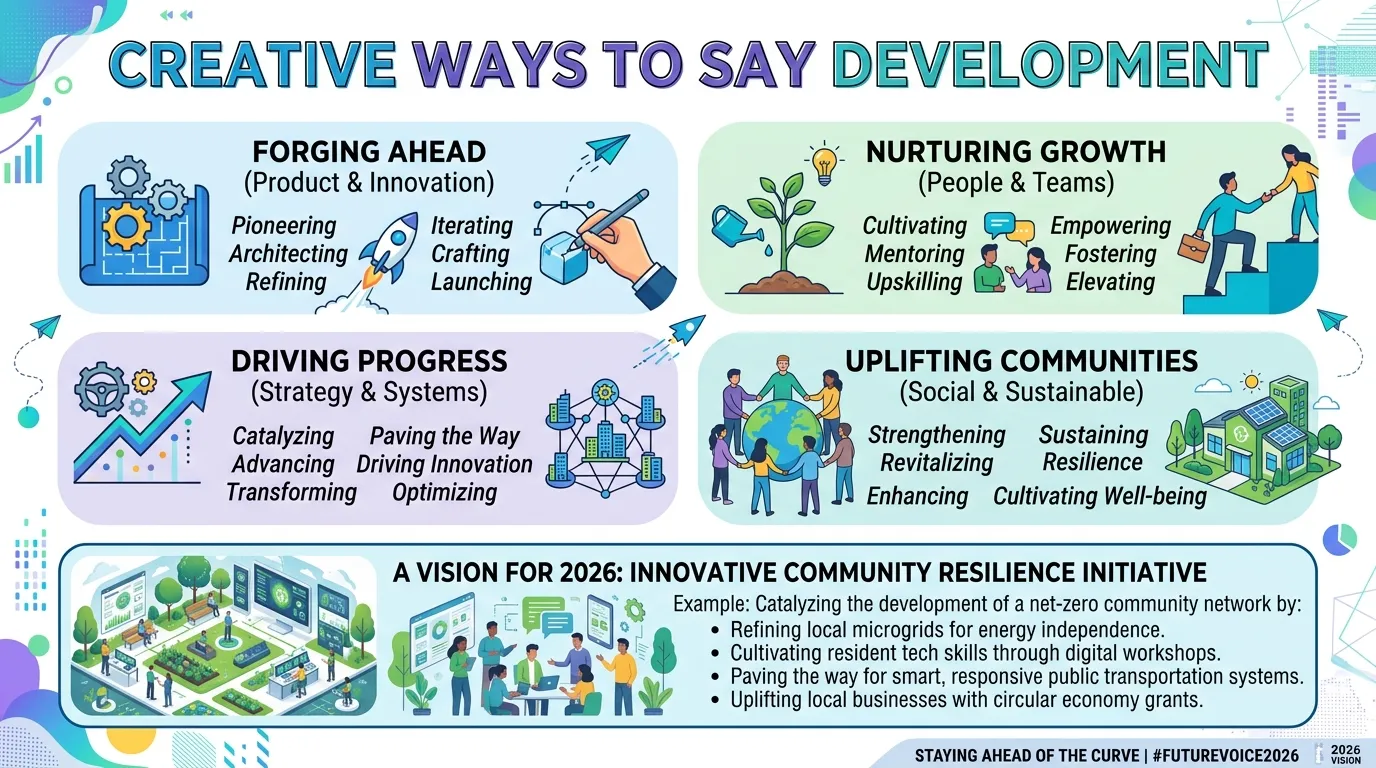
This guide gives you 158 fresh alternatives organized by context: general growth, business, personal growth, projects, technology, and creativity. Every option comes with an example sentence, plus tips for picking the perfect word every time.
Quick pick: In a hurry? These six fit almost anywhere.
- Growth – the most natural all-purpose replacement.
- Progress – best for step-by-step forward movement.
- Advancement – polished and professional for formal writing.
- Evolution – ideal for ideas, style, or gradual change.
- Expansion – perfect for size, reach, or markets.
- Breakthrough – for sudden, dramatic leaps forward.
Why Writers Overuse the Word Development
Development is a comfort word. It is vague enough to cover growth, change, building, learning, and progress all at once, so writers reach for it without thinking. The problem is that vague words ask the reader to do the interpreting. When you replace it with a sharper word, you do that work for them, and your writing instantly feels clearer and more confident. Variety also keeps rhythm alive: a paragraph that moves from growth to progress to expansion reads far better than one that repeats development three times.
General Alternatives for Growth and Progress
These all-purpose options work in essays, articles, speeches, and everyday writing whenever you mean forward movement or improvement.
- Growth – “The charity saw remarkable growth in volunteers this year.”
- Progress – “We are pleased with the progress of the renovation.”
- Advancement – “The advancement of clean energy depends on smart policy.”
- Improvement – “Regular practice led to steady improvement in her writing.”
- Expansion – “The expansion of the library gave students far more space.”
- Evolution – “The evolution of the brand took nearly a decade.”
- Forward movement – “The talks finally showed some forward movement.”
- Upward trend – “Sales show a clear upward trend since spring.”
- Betterment – “He dedicated his life to the betterment of his town.”
- Headway – “The team is making real headway on the new design.”
- Stride – “The country has made great strides in literacy.”
- Maturation – “The maturation of the market brought stable prices.”
- Flourishing – “The flourishing of local art surprised everyone.”
- Upswing – “The upswing in tourism helped small shops recover.”
Business and Career Alternatives
In reports, pitches, and resumes, precise business language builds credibility. These options sound professional without sounding stiff.
- Business growth – “The report highlights strong business growth in Asia.”
- Market expansion – “Market expansion into two new cities starts in June.”
- Revenue growth – “Revenue growth doubled after the pricing change.”
- Scaling – “Scaling the platform was our main goal this quarter.”
- Professional advancement – “The course supports your professional advancement.”
- Career progression – “She mapped out a clear career progression plan.”
- Corporate growth – “Corporate growth slowed during the uncertain year.”
- Commercial progress – “The startup reported solid commercial progress.”
- Enterprise expansion – “Enterprise expansion required hiring forty people.”
- Brand evolution – “The brand evolution won praise from longtime customers.”
- Operational improvement – “Operational improvement cut delivery times in half.”
- Strategic growth – “Strategic growth matters more than fast growth.”
Personal Growth Alternatives
When the topic is self-improvement, warm human words beat corporate jargon. These fit journals, coaching content, and motivational writing.
- Personal growth – “Travel sparked a period of intense personal growth.”
- Self-improvement – “His commitment to self-improvement inspired the whole group.”
- Inner growth – “Meditation supported her inner growth through a hard year.”
- Self-discovery – “The course became a journey of self-discovery.”
- Character building – “Team sports played a big role in his character building.”
- Life progress – “She felt real life progress for the first time in years.”
- Maturity – “The experience brought a new maturity to his decisions.”
- Self-mastery – “Self-mastery takes patience, not perfection.”
- Personal transformation – “The move led to a quiet personal transformation.”
- Becoming – “She embraced the slow becoming of her new self.”
Project and Product Alternatives
Project updates and product writing need concrete, active words. These keep stakeholders engaged and make timelines feel alive.
- Build-out – “The build-out of the new office finished ahead of schedule.”
- Rollout – “The rollout of the feature took three careful phases.”
- Execution – “Strong execution turned the plan into real results.”
- Implementation – “The implementation of the new system went smoothly.”
- Construction – “Construction of the community center began in March.”
- Formation – “The formation of the partnership took months of talks.”
- Shaping – “Months of shaping gave the idea its final form.”
- Cultivation – “The cultivation of the client list paid off fast.”
- Elaboration – “The elaboration of the concept impressed the judges.”
- Realization – “The realization of the vision took five years.”
Technology and Innovation Alternatives
Tech writing moves fast, and so should its vocabulary. These alternatives sound current without aging quickly.
- Innovation – “Innovation in battery tech is accelerating every year.”
- Modernization – “The modernization of the grid will take a decade.”
- Digital transformation – “Digital transformation reshaped how the bank serves customers.”
- Tech advancement – “Each tech advancement brings new questions about privacy.”
- Iteration – “Constant iteration made the app feel effortless.”
- Upgrade cycle – “A faster upgrade cycle kept users excited.”
- Breakthrough – “The breakthrough in chip design shocked the industry.”
- Leap forward – “The new model is a real leap forward in speed.”
Creative and Artistic Alternatives
Creative work grows in fits and starts, and these words capture that organic, unfolding feeling better than the clinical “development” ever could.
- Unfolding – “The slow unfolding of the plot kept readers hooked.”
- Blossoming – “Her blossoming as a painter happened almost overnight.”
- Refinement – “Endless refinement gave the song its polish.”
- Crafting – “The crafting of the novel took four patient years.”
- Deepening – “A deepening of his style marked the later albums.”
- Exploration – “The exploration of new textures defined her latest work.”
- Germination – “The germination of the idea happened on a long walk.”
- Coming into bloom – “His photography is truly coming into bloom this year.”
How to Pick the Right Alternative Every Time
Choosing well is simple once you ask three questions. First, what is actually happening? If something is getting bigger, use growth or expansion. If it is moving step by step, use progress. If it is changing form, use evolution or transformation. Second, who is reading? Business readers respect advancement and scaling, while personal essays shine with becoming and unfolding. Third, how fast is it? Gradual change calls for maturation or deepening, while sudden change deserves breakthrough or leap forward. Match the word to the reality, and your writing will always sound precise.
This guide gives you 158 fresh alternatives organized by context: general growth, business, career, software and technology, personal growth, and community plus real estate. Every option comes with a real usage example sentence, plus practical tips for picking the perfect word every time.
Quick Pick: Six Alternatives That Fit Almost Anywhere
In a hurry? These six work in nearly every sentence where development feels tired.
- Growth: the most natural all-purpose replacement.
- Progress: best for step by step forward movement.
- Advancement: polished and professional for formal writing.
- Evolution: ideal for ideas, style, or gradual change.
- Expansion: perfect for size, reach, or markets.
- Breakthrough: best for sudden, dramatic leaps forward.
Development is a comfort word. It is vague enough to cover growth, change, building, learning, and progress all at once, so writers reach for it without thinking. The problem is that vague words ask the reader to do the interpreting. When you replace it with a sharper word, you do that work for them, and your writing instantly feels clearer and more confident. Variety also keeps rhythm alive. A paragraph that moves from growth to progress to expansion reads far better than one that repeats development three times.
- 1. Growth: “The charity saw remarkable growth in volunteers this year.”
- 2. Progress: “We are pleased with the progress of the renovation.”
- 3. Advancement: “The advancement of clean energy depends on smart policy.”
- 4. Improvement: “Daily practice led to steady improvement in her writing.”
- 5. Expansion: “The expansion of the library gave students far more space.”
- 6. Evolution: “The evolution of the brand took nearly a decade.”
- 7. Increase: “An increase in orders forced the team to hire quickly.”
- 8. Maturation: “The maturation of the market brought steadier prices.”
- 9. Progression: “The natural progression of the project pleased every stakeholder.”
- 10. Flourishing: “The flourishing of local art surprised the whole town.”
- 11. Headway: “The team is making real headway on the new design.”
- 12. Strides: “The country has made great strides in literacy.”
- 13. Betterment: “He dedicated his life to the betterment of his town.”
- 14. Upswing: “The upswing in tourism helped small shops recover.”
- 15. Forward movement: “The talks finally showed some forward movement.”
Business Growth Alternatives
In reports, pitches, and boardrooms, precise business language builds credibility. These options sound professional without sounding stiff.
- 16. Market expansion: “Market expansion into two new cities begins in June.”
- 17. Revenue growth: “Revenue growth doubled after the pricing change.”
- 18. Scaling: “Scaling the platform was our main goal this quarter.”
- 19. Strategic growth: “Strategic growth matters more than fast growth.”
- 20. Corporate growth: “Corporate growth slowed during the uncertain year.”
- 21. Commercial progress: “The startup reported solid commercial progress.”
- 22. Business scaling: “Business scaling required new systems and fresh hires.”
- 23. Enterprise growth: “Enterprise growth came from three strong divisions.”
- 24. Brand evolution: “The brand evolution won praise from longtime customers.”
- 25. Operational improvement: “Operational improvement cut delivery times in half.”
- 26. Diversification: “Diversification into new product lines reduced their risk.”
- 27. Market penetration: “Deeper market penetration lifted profits this year.”
- 28. Portfolio expansion: “Portfolio expansion gave the firm steadier income.”
- 29. Business advancement: “The grant will support business advancement in rural areas.”
- 30. Profit growth: “Profit growth impressed every shareholder at the meeting.”
Career Advancement Alternatives
Resumes, reviews, and cover letters need language that sounds ambitious yet honest. These alternatives show movement without the vague filler word.
- 31. Career progression: “She mapped out a clear career progression plan.”
- 32. Professional advancement: “The course supports your professional advancement.”
- 33. Skill building: “Skill building workshops filled the training calendar.”
- 34. Leadership growth: “The role offered real leadership growth and mentorship.”
- 35. Career growth: “He joined the company for faster career growth.”
- 36. Upward mobility: “The program promises upward mobility for its graduates.”
- 37. Promotion path: “A clear promotion path keeps top talent engaged.”
- 38. Professional growth: “Her mentor guided her professional growth for years.”
- 39. Career advancement: “The degree opened doors to rapid career advancement.”
- 40. Job progression: “Steady job progression matters more than a fancy title.”
- 41. Workplace advancement: “The policy promotes fair workplace advancement for all.”
- 42. Competency building: “Competency building programs raised team performance.”
- 43. Role expansion: “Role expansion gave her wider influence and new skills.”
- 44. Career building: “Career building takes patience, networking, and steady effort.”
- 45. Talent growth: “The company invests heavily in talent growth each year.”
Software and Technology Alternatives
- 46. Innovation: “Innovation in battery tech is accelerating every year.”
- 47. Iteration: “Constant iteration made the app feel effortless.”
- 48. Modernization: “The modernization of the grid will take a decade.”
- 49. Digital transformation: “Digital transformation reshaped how the bank serves customers.”
- 50. Breakthrough: “The breakthrough in chip design shocked the industry.”
- 51. Leap forward: “The new model is a real leap forward in speed.”
- 52. Tech advancement: “Each tech advancement brings new questions about privacy.”
- 53. Feature rollout: “The feature rollout happened in three careful phases.”
- 54. System upgrade: “A full system upgrade cut downtime to minutes.”
- 55. Code refinement: “Months of code refinement made the app far faster.”
- 56. Platform evolution: “The platform evolution added tools developers love.”
- 57. Build cycle: “A shorter build cycle shipped fixes every week.”
- 58. Release cycle: “The faster release cycle kept users excited and loyal.”
- 59. Prototype refinement: “Prototype refinement turned the rough idea into a hit.”
- 60. Technical progress: “The quarterly report highlighted strong technical progress.”
- 61. Personal growth: “Travel sparked a period of intense personal growth.”
- 62. Self-improvement: “His commitment to self-improvement inspired the whole group.”
- 63. Self-discovery: “The course became a journey of self-discovery.”
- 64. Inner growth: “Meditation supported her inner growth through a hard year.”
- 65. Character building: “Team sports played a big role in his character building.”
- 66. Life progress: “She felt real life progress for the first time in years.”
- 67. Maturity: “The experience brought new maturity to his decisions.”
- 68. Self-mastery: “Self-mastery takes patience, not perfection.”
- 69. Personal transformation: “The move led to a quiet personal transformation.”
- 70. Becoming: “She embraced the slow becoming of her new self.”
- 71. Self-actualization: “Years of effort brought him closer to self-actualization.”
- 72. Mindset shift: “A simple mindset shift doubled her confidence.”
- 73. Personal enrichment: “Evening classes added personal enrichment to her routine.”
- 74. Life refinement: “Small changes brought real life refinement over time.”
- 75. Emotional growth: “Honest conversations supported his emotional growth.”
Community, Economic, and Real Estate Alternatives
Civic writing and property coverage need grounded, specific language. These options replace the vague word with words that show real places changing.
- 76. Community progress: “New parks marked real community progress this year.”
- 77. Economic growth: “Economic growth lifted wages across the region.”
- 78. Urban renewal: “Urban renewal turned the old district into a thriving hub.”
- 79. Neighborhood revitalization: “Neighborhood revitalization brought new shops and safer streets.”
- 80. Property construction: “Property construction created hundreds of local jobs.”
- 81. Housing expansion: “Housing expansion eased the rental shortage downtown.”
- 82. Building project: “The building project finished two months early.”
- 83. Site planning: “Careful site planning prevented costly delays later.”
- 84. Infrastructure improvement: “Infrastructure improvement cut commute times across the city.”
- 85. Regional advancement: “Regional advancement followed the new trade agreement.”
- 86. Civic improvement: “Civic improvement programs cleaned every public park.”
- 87. Economic revitalization: “Economic revitalization brought factories back to the valley.”
- 88. Community building: “Years of community building created lasting trust.”
- 89. Urban growth: “Rapid urban growth demanded better public transport.”
- 90. Public works progress: “The mayor praised steady public works progress.”
Formal Versus Casual: Matching Tone
Context decides tone. In formal writing, such as annual reports, grant proposals, and academic papers, prefer advancement, operational improvement, infrastructure improvement, and professional advancement. These carry weight and respect. In casual writing, such as blogs, newsletters, and team updates, growth, headway, leap forward, and becoming feel natural and human. The same event can be market expansion in the investor deck and exciting growth in the team email. Choosing tone consciously keeps you credible in both rooms.
Common Mistakes to Avoid
The biggest mistake is repeating development five times in one page when each use means something different. Scan your draft, list every use, and give each one the exact word it deserves. The second mistake is picking a fancy synonym that misleads, such as calling a small tweak a breakthrough or a slow trend an explosion. Overselling erodes trust. The third mistake is mixing tones, like dropping becoming into a financial report or market penetration into a love letter to your hometown. Match the word to both meaning and audience, and you will never go wrong.
Growth is the safest all-purpose replacement, and progress is a close second. For formal writing, advancement works beautifully. The best choice always depends on context, so start with the quick pick list and narrow down from there.
What is another way to say development on a resume?
For creative contexts, try unfolding, blossoming, evolution, or becoming. These carry imagery and emotion, which is exactly what creative writing needs.
Is it okay to keep using the word development sometimes?
Frequently Asked Questions
What is the best single replacement for the word development?
Growth is the safest all-purpose replacement, and progress is a close second. For formal writing, advancement works beautifully. The best choice always depends on context, so use the quick-pick list as your starting point.
How do I stop repeating development in a report?
List the sections where the word appears, then assign a different alternative to each one based on meaning. A business section can use market expansion, a team section can use professional advancement, and a timeline section can use progress. The repetition disappears naturally.
Is it okay to use development at all?
Yes. The goal is variety, not elimination. Keep development for the one or two places where it fits best, such as a formal title, and use alternatives everywhere else. One strong use beats five weak ones.
What is another way to say development in a resume?
Resumes love action language. Try career progression, professional advancement, skill building, or leadership growth. Each one sounds more specific and more impressive than the generic word.
What is a more creative way to say development?
For creative contexts, try unfolding, blossoming, evolution, or coming into bloom. These carry imagery and emotion, which is exactly what creative writing needs.
How to Choose the Right Alternative
Start with the setting. The best replacement for development in a formal email is rarely the best one in a quick text, so decide where the line will be read before you decide which line to send.
Next, match the tone to your relationship with the reader. People you know well can handle playful and informal wording, while new contacts, managers, and clients usually respond better to steady and polite wording.
Finally, check the meaning. Say the alternative out loud in the full sentence. If it keeps the sense of development, sounds natural, and needs no explanation, it is the right choice. If you have to explain it, pick a simpler one.
Development Words for Grant Proposals and Annual Reports
Formal reports need words that sound measured and accountable. Choose terms that name real movement, such as growth in reach, progress against a plan, or advancement toward a stated goal, and pair each word with one figure or milestone from the year.
- Program expansion supported by clear enrollment figures
- Operational improvement shown in shorter delivery times
- Professional advancement for staff completing training
- Community progress measured in new services opened
- Strategic growth guided by the original plan
Formal language earns trust when it stays concrete. One measured word plus one honest number beats a page of vague progress claims.
How to Vary Development Words Across a Long Report
Long reports repeat the same idea in many sections, so assign each section its own word before writing. Give the opening section growth, the methods section progress, the results section advancement, and the closing section evolution, and the repetition will fade without losing meaning.
- List every section that currently uses the same word.
- Assign a different alternative to each section by meaning.
- Check that each new word fits its section tone.
- Read the headings in order for variety and flow.
- Keep one strong use of the original word for the title.
A varied report reads as thoughtful rather than templated. Small word choices, made early, keep a long document feeling fresh to the end.
Development Alternatives for Education and Learning
Education writing needs development alternatives that fit the classroom, because a vague word can hide how a student actually grows. A word like learning fits new skills, while a word like progress fits steady steps over a term, and a word like mastery fits a skill that is finally secure. The best lines also name the subject, like reading growth in grade three or steady progress in maths, so the reader sees the change, not only the claim. Avoid words that sound like a business report, because a classroom story needs warmth and care, not cold numbers. A clear word plus a real example shows the teacher, the parent, and the student exactly what changed. That clarity is what turns a school report into a story of real learning.
- Her reading growth this term shows in every book she now finishes alone.
- Steady progress in maths, with clear steps from counting to problem solving.
- His mastery of the times tables came after weeks of patient practice.
- The class shows real learning in science, with careful notes and sharp questions.
- Her writing skills advanced quickly, from short lines to full stories.
- The new course improved spelling for most pupils in just one term.
- The new reading scheme raised scores across the school, with happy pupils and proud parents.
Development Alternatives for Health and Wellness
Health writing needs development alternatives that sound gentle, because a harsh word can make a reader feel judged instead of helped. A word like recovery fits healing after illness, while a word like improvement fits small daily gains, and a word like wellbeing fits a calm and balanced life. The best lines also name the habit, like daily walks or better sleep, so the reader sees a clear path, not a vague promise. Avoid words that sound like a sales pitch, because health advice needs trust, not hype. A kind word plus a small step shows the reader that change can be slow and still real. That gentle tone is what turns health advice into a habit people keep, not a goal they fear.
- Her recovery after the operation was slow, steady, and full of small wins.
- Daily walks brought clear improvement in his energy and his mood.
- Better sleep improved her focus, and her mornings feel calm again.
- The new routine supports wellbeing with simple food and gentle exercise.
- His strength returned step by step, with care from family and doctors.
- A balanced life grows from small habits, repeated with patience every day.
- Gentle stretching each morning eased his stiff joints and lifted his mood.
Conclusion
The next time you catch yourself typing development for the third time in one page, pause and pick another way to say development from this list. Whether it is growth, progress, evolution, or breakthrough, the sharper word will make your meaning clearer and your writing more enjoyable to read. Precision is a habit, and it starts with one better word.