I still remember a time when I was working on a content project and I kept using the phrase makes sense over and over again. I felt my writing sounded repetitive, and honestly, it didn’t look professional at all.
While working on it, I realized I needed a better way to express the same idea without sounding boring or stuck.
So, I started searching for an Another Way to Say Makes Sense because I wanted my communication to feel more natural and engaging. I explored different alternatives and tested them in my writing and conversations.
At first, it was a little confusing because not every phrase fits in every situation, but I kept practicing.
Slowly, I improved. I began using phrases like that sounds reasonable, I understand, or that adds up, depending on the context. It made my writing smoother and more professional. I also noticed people responded better when I varied my expressions instead of repeating the same words.
Now, whenever I write or speak, I always keep in mind that there is more than one way to say things. Finding an Another Way to Say Makes Sense really helped me improve my communication skills and made my content much more effective and natural.
Let,s dive in!
Everyday Ways to Say Makes Sense
- That works
- I get it
- Sounds right
- I understand
- That fits
- Seems fair
- That checks out
- I follow you
- Got it
- That adds up
- I see your point
- Totally clear
- I hear you
- That feels right
- All clear
- Makes perfect sense to me
- I see what you mean
- That explains it
- Fair enough
- I understand now
Casual Conversation Alternatives
- Yep that works
- I’m with you
- Okay I see
- That clicks
- Makes total sense
- Right on
- Good point
- True enough
- I can see that
- That tracks
- Sounds good
- That lands well
- No confusion there
- I’m following
- That lines up
- Seems logical
- I get your idea
- That makes it clear
- Easy to understand
- Works for me
Professional and Workplace Options
- That is reasonable
- The logic is clear
- This is understandable
- That aligns well
- The reasoning is solid
- That is valid
- I agree with the logic
- This seems practical
- That is justified
- The explanation works
- This is well explained
- That holds up
- The idea is clear
- That is sound reasoning
- This approach works
- The point is clear
- That seems appropriate
- I understand the reasoning
- That is logical
- This makes practical sense
Friendly Agreement Phrases
- I agree
- You are right
- Good thinking
- That sounds smart
- I like that idea
- That feels correct
- I support that
- I can agree with that
- That works well
- Nicely said
- I see why
- That feels true
- I’m convinced
- Good reasoning
- I accept that
- That sounds fair
- You make a good case
- That settles it
- I buy that
- Well said
Simple Explanatory Responses
- Now I understand
- That clears things up
- Thanks that helps
- That explains everything
- Crystal clear
- Now it makes sense
- I understand better
- That helps a lot
- The picture is clear
- I get the idea now
- That answers my question
- Everything fits now
- That removes confusion
- I see the logic
- That explains why
- I understand your meaning
- Clear explanation
- The idea connects
- That solves it
- I follow completely
Logical and Analytical Alternatives
- The reasoning works
- The logic stands
- That follows logically
- The argument holds
- That conclusion fits
- The explanation connects
- That is coherent
- The thinking is clear
- That aligns logically
- The idea holds together
- That conclusion works
- The logic flows
- That reasoning checks out
- The explanation is sound
- That fits the facts
- The reasoning is consistent
- That conclusion makes sense
- The logic supports it
- That is rational
- The thinking adds up
Supportive and Encouraging Responses
- Great explanation
- You explained it well
- That helps me understand
- Nice clarity
- Good insight
- Helpful point
- You made it simple
- Easy to follow
- That makes things easier
- I appreciate that explanation
- Clear thinking
- Thanks for explaining
- Very understandable
- You made it clear
- That works nicely
- Helpful reasoning
- Well clarified
- That made it simple
- Good clarity there
- I understand fully
Informal Text and Chat Replies
- Gotcha
- Makes sense lol
- Ahh I see
- Okay got it
- Yep makes sense
- All good
- Cool I get it
- Ohhh okay
- Now I see
- That works haha
- Clear enough
- Fair point
- I see now
- Sounds legit
- Makes sense to me
- Yeah I get that
- That explains it lol
- Okay makes sense now
- Right got it
- I’m good with that
Polite Agreement Expressions
- I understand your view
- That seems reasonable to me
- I appreciate the explanation
- That is understandable
- I respect that reasoning
- That sounds acceptable
- I follow your logic
- Thank you for clarifying
- That is easy to understand
- I acknowledge your point
- Your reasoning is clear
- That seems sensible
- I accept that explanation
- That appears correct
- Your point is clear
- I see your reasoning
- That sounds appropriate
- I recognize the logic
- That makes good sense
- I agree with that perspective
Teaching and Learning Context Phrases
- The idea is clear
- Students can follow this
- The concept works
- That explanation helps learning
- The lesson connects
- The point is understood
- The example works well
- The concept clicks
- That simplifies things
- Easy to grasp
- The idea becomes clear
- The meaning is obvious
- That clarifies the concept
- The explanation fits
- The logic helps learning
- That supports understanding
- The reasoning teaches well
- That makes learning easier
- The message is clear
- The concept makes sense
Confident Agreement Statements
- Absolutely logical
- Clearly correct
- That is obvious now
- Completely reasonable
- Without doubt
- Perfectly logical
- Totally valid
- Clearly explained
- No confusion there
- Fully understandable
- That stands strong
- Clearly sensible
- Strong reasoning
- That is convincing
- Makes perfect sense
- Clearly aligned
- That is undeniable
- The point is solid
- Strong logic there
- Completely clear
Conclusion
In conclusion, finding another way to say makes sense can improve your writing and conversations by adding variety and clarity.
Phrases like sounds reasonable, is understandable, or seems logical help express agreement more naturally in different situations. Using fresh alternatives also keeps your content engaging and professional.
If for casual talks, academic writing, or online content, choosing the right synonym can make your message clearer, stronger, and more appealing to readers in 2026.
Makes sense is the phrase everyone reaches for when something clicks. A coworker explains a plan, a friend tells a story, a teacher walks through a problem, and out comes those two familiar words. The meaning is simple: I understand, that is logical, your point is clear. But constant repetition turns a useful phrase into verbal wallpaper. This guide gives you 273 plus alternatives to makes sense, sorted into smart, casual, and witty groups. Every option includes a clear meaning and a real example sentence, so you can agree, confirm, and acknowledge with fresh words in any conversation.
Smart Alternatives to Makes Sense
These intelligent options work well in meetings, classrooms, professional discussions, and any setting where you want to sound thoughtful.
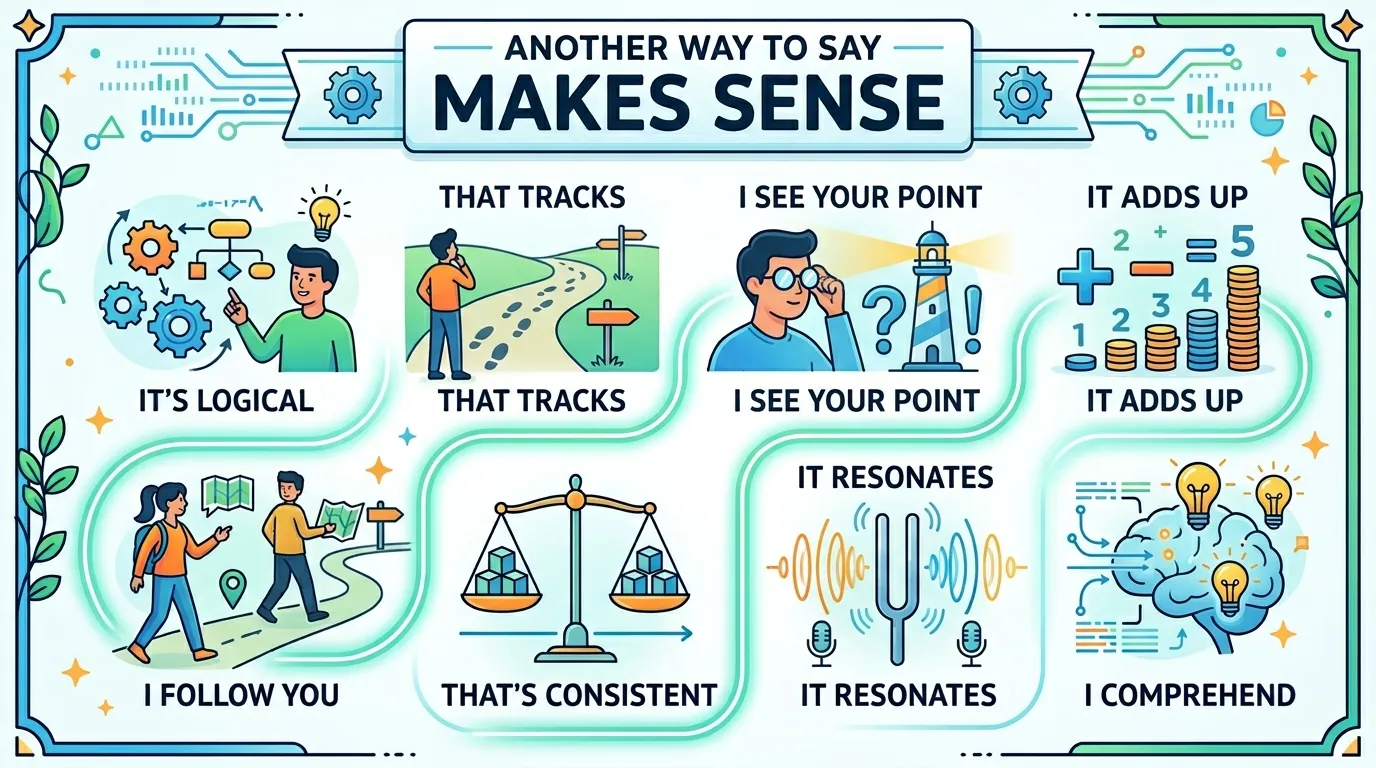
That is logical
Meaning: The reasoning follows a clear, sound pattern.
Example: “Given the data, that is logical and we should proceed.”
I see your point
Meaning: I understand the argument you are making.
Example: “I see your point about starting with a smaller test group.”
That tracks
Meaning: Modern slang for saying the information lines up with what you expected.
Example: “He missed the meeting because of traffic? That tracks.”
That is reasonable
Meaning: The idea is fair, sensible, and easy to accept.
Example: “Asking for two extra days is reasonable given the workload.”
I follow you
Meaning: I am tracking your explanation step by step.
Example: “I follow you so far, keep going with the plan.”
That adds up
Meaning: The details combine into a believable whole.
Example: “Once she explained the timeline, everything adds up.”
Crystal clear
Meaning: Completely understandable, with zero confusion.
Example: “Your instructions were crystal clear.”
That is coherent
Meaning: The idea holds together logically from start to finish.
Example: “His argument was coherent and backed by solid evidence.”
I understand completely
Meaning: Full comprehension, no doubts remaining.
Example: “I understand completely why you chose the safer route.”
That is sound reasoning
Meaning: The logic behind the idea is solid and well built.
Example: “Delaying the launch until testing finishes is sound reasoning.”
It is all clear to me
Meaning: A confident way to confirm total understanding.
Example: “After the demo, it is all clear to me.”
That resonates
Meaning: The idea connects with your own experience or feelings.
Example: “Her point about rest being productive really resonates.”
Casual Alternatives to Makes Sense
For everyday chats, texts, and relaxed conversations, these friendly options keep things flowing naturally.
Got it
Meaning: Short and universal, I understand.
Example: “Got it, I will bring the snacks on Saturday.”
Fair enough
Meaning: I accept your point, even if I had not thought of it that way.
Example: “You want to leave early to beat traffic? Fair enough.”
Totally
Meaning: Enthusiastic agreement, popular in casual speech.
Example: “We should order extra fries. Totally.”
Yep, I get it
Meaning: Warm confirmation of understanding.
Example: “Yep, I get it, the early bird gets the parking spot.”
Checks out
Meaning: The information matches what you know or expected.
Example: “His story about the flat tire checks out.”
No doubt
Meaning: Strong agreement with zero hesitation.
Example: “That movie was amazing. No doubt.”
Obviously
Meaning: The point is clear and almost self-evident.
Example: “Obviously we need more time for a project this big.”
Right
Meaning: Simple agreement, often said with a nod.
Example: “So we meet at noon? Right.”
Say no more
Meaning: I understand already, no further explanation needed.
Example: “Say no more, I will handle the invitations.”
Of course
Meaning: Natural agreement, as if the point were obvious.
Example: “Of course the kids loved the water park.”
Witty Alternatives to Makes Sense
When you want to agree with style, humor, or a little flair, these clever options make your response memorable.
The math is mathing
Meaning: Playful internet slang for saying the logic works out.
Example: “She studied all week and aced the test? The math is mathing.”
Big brain move
Meaning: A smart idea, praised with internet humor.
Example: “Bringing snacks to the long meeting was a big brain move.”
You are speaking my language
Meaning: I agree so strongly it feels like we think alike.
Example: “Pizza for dinner again? You are speaking my language.”
That is the tea
Meaning: That is the truth, stated with dramatic flair.
Example: “Sleep beats scrolling at midnight. That is the tea.”
Preach
Meaning: Enthusiastic agreement, as if the speaker said something profound.
Example: “Weekends should be three days long. Preach.”
Case closed
Meaning: The point is proven and no more debate is needed.
Example: “The dog clearly ate the homework. Case closed.”
Mystery solved
Meaning: The confusing thing now has a clear explanation.
Example: “The noise was just the wind. Mystery solved.”
Bonus Alternatives to Makes Sense
More ways to agree, confirm, and show understanding in any conversation.
Agreed
Meaning: I share your view completely.
Example: “We should leave before the storm. Agreed.”
Absolutely
Meaning: Strong, total agreement with enthusiasm.
Example: “Absolutely, safety always comes first.”
You are right
Meaning: Confirming that their point is correct.
Example: “You are right, the early flight is much cheaper.”
I concur
Meaning: Formal agreement, common in meetings.
Example: “I concur with the proposed budget.”
Point taken
Meaning: I accept your point and will act on it.
Example: “Point taken, we will start the meeting earlier.”
Well said
Meaning: Praising both the idea and how it was expressed.
Example: “Well said, kindness really does cost nothing.”
True
Meaning: Simple, honest confirmation.
Example: “True, practice really does make progress.”
Exactly
Meaning: Precisely what I was thinking too.
Example: “Exactly, that is what I meant to say.”
For sure
Meaning: Certain, confident agreement.
Example: “For sure, weekends are far too short.”
You got it
Meaning: I understand and I agree to help.
Example: “You got it, I will handle lunch orders.”
Makes perfect sense
Meaning: An emphatic version that shows strong understanding.
Example: “It makes perfect sense to start with a small pilot.”
That is spot on
Meaning: Exactly correct, praised with warmth.
Example: “Your summary of the book is spot on.”
Could not agree more
Meaning: The strongest possible agreement.
Example: “I could not agree more about the new policy.”
You read my mind
Meaning: We think so alike it is almost funny.
Example: “You read my mind, I wanted pizza too.”
One hundred percent
Meaning: Total, unqualified agreement.
Example: “One hundred percent, rest is productive too.”
Understood
Meaning: I have fully taken in what you said.
Example: “Understood, I will start the report today.”
Noted
Meaning: I heard you and registered the point.
Example: “Noted, the meeting moved to Tuesday.”
Copy that
Meaning: Message received, borrowed from radio talk.
Example: “Copy that, heading to the lobby now.”
Roger
Meaning: Understood, said with playful radio lingo.
Example: “Roger, snacks are already on the list.”
Ten four
Meaning: Okay and understood, from CB radio slang.
Example: “Ten four, I will pick you up at six.”
Loud and clear
Meaning: Heard and understood perfectly.
Example: “Your instructions came through loud and clear.”
Message received
Meaning: I got exactly what you are saying.
Example: “Message received, no more late nights this week.”
Crystal
Meaning: Short and stylish for crystal clear.
Example: “The plan is crystal, let us get moving.”
Duly noted
Meaning: Understood and mentally recorded.
Example: “Duly noted, I will adjust the plan today.”
Quick Pick
Quick Pick: In professional settings, that is logical and I see your point show respect and intelligence. In casual conversation, got it and fair enough keep things friendly. For playful moments, the math is mathing gets laughs while still agreeing. Choose based on your audience, because a witty internet phrase in a board meeting lands very differently than it does in a group chat.
Makes Sense Alternatives for Meetings
Meetings run on quick agreement, and makes sense alternatives keep that agreement precise. That tracks with what we have seen ties agreement to evidence. That logic holds up suits analytical discussions. I follow your reasoning completely is warmer and works well with colleagues you respect. These alternatives beat a plain makes sense because they say what you agree with and why, which moves the meeting forward instead of just nodding at it.
Best use: add one short reason after your agreement in meetings. Agreement plus a reason builds shared understanding, while bare agreement can hide confusion that surfaces later.
How to Agree With an Idea in Writing
Written agreement should be clear enough that no one misreads it later. Your reasoning is sound, and I support this direction is unambiguous. This approach makes sense given the timeline ties agreement to a constraint, which helps future readers understand the choice. I agree, with one small addition is the honest way to agree mostly while still improving the idea.
Best use: in writing, state agreement in the first line of your reply, then add questions or additions after. Readers scanning long threads should find your position at once, not buried under caveats.
Makes Sense Replies for Customer Service and Support Chats
Customer service chats move fast, and a reply like makes sense can sound warm or careless depending on the words around it. When a customer explains a problem, the agent should first show that the problem was heard, then agree with the point, and then offer the next step. A line like that makes complete sense, and here is how we can fix it sounds helpful and human, while a bare makes sense can feel like a brush off. Adding one detail from the customer story, like the missing parcel or the wrong charge, proves that the agent read the message with care. That small proof builds trust, and trust is what turns an unhappy customer into a loyal one.
- That makes complete sense, and I can see why the delay upset you.
- Absolutely, that makes sense, let me check your order right now.
- You are right, that makes sense, and I will fix the charge today.
- That makes perfect sense, thank you for explaining it so clearly.
- I see what you mean, that makes sense, and here is the next step.
- That makes total sense, and I will stay with you until it is solved.
Makes Sense Lines for Group Projects and Study Teams
Group projects work best when every member feels heard, and a makes sense reply can do that job well when it is used with care. In a study team, the line should agree with the idea and also move the work forward, like that makes sense, let us test it with the first chapter. A flat agreement without a next step can stall the group, because nobody knows what happens next. The strongest replies add a question, a task, or a small piece of praise, so the speaker feels valued and the team gains momentum. Avoid using the line to end a discussion early, because a quick agreement can hide a doubt that later becomes a problem.
- That makes sense, let us try it on the first section and see how it feels.
- Yes, that makes sense to me, and it fits the notes from last week.
- That makes a lot of sense, can you show us the example you mean.
- That makes sense, and it solves the timing problem we had yesterday.
- Good point, that makes sense, let us split the work this way.
- That makes sense to everyone, I think, so let us move to the next part.
More Questions Readers Ask
Is makes sense rude in customer service chats? It is not rude by itself, but it can feel cold when it stands alone. Add warmth and a next step, like that makes complete sense, and here is how we can fix it, so the customer feels heard and helped.
How do I agree in a group project without sounding passive? Agree and then add action, like that makes sense, let us test it on the first section. An agreement with a clear next step shows leadership, while a bare agreement can sound like you are only following along.
What is a warmer way to say makes sense to a friend? Try you are absolutely right, or I see exactly what you mean, because both lines show real listening. Warmth comes from naming the idea, not only from agreeing with it, so repeat one detail back to the speaker.
Frequently Asked Questions
Is it rude to say makes sense?
Usually not, but it can sound dismissive if said flatly or too quickly, as if you are rushing past someone’s point. Slowing down and choosing a warmer option like I see your point shows you actually listened.
What is a more intelligent way to say makes sense?
That is logical, that is sound reasoning, and that is coherent all sound sharper. They show you evaluated the idea instead of just nodding along.
How do you agree with someone in a funny way?
The math is mathing, big brain move, and you are speaking my language agree with humor built in. They work best with friends and in relaxed settings.
Can makes sense sound condescending?
Yes, in the wrong tone. Saying it slowly to someone who just explained something simple can feel patronizing. When in doubt, pick got it or crystal clear, which confirm understanding without talking down.
What is the best one-word alternative to makes sense?
Obviously and totally are the most natural one-word options in casual speech. In professional settings, agreed does the same job cleanly.
Agreement is a small moment, but the words you choose shape how people feel about the conversation. Makes sense gets the job done, yet it rarely makes anyone feel heard. A thoughtful I see your point, a warm fair enough, or a playful the math is mathing each carry the same meaning with far more personality. Keep this list within reach and rotate your responses. Your conversations will feel fresher, your listeners will feel more valued, and that tired old phrase can finally take a well-earned rest.
How to Choose the Right Alternative
Start with the setting. The best replacement for makes sense in a formal email is rarely the best one in a quick text, so decide where the line will be read before you decide which line to send.
Next, match the tone to your relationship with the reader. People you know well can handle playful and informal wording, while new contacts, managers, and clients usually respond better to steady and polite wording.
Finally, check the meaning. Say the alternative out loud in the full sentence. If it keeps the sense of makes sense, sounds natural, and needs no explanation, it is the right choice. If you have to explain it, pick a simpler one.
Common Mistakes to Avoid
The most common mistake is using a formal alternative in a casual moment, or a casual one in a formal moment. A replacement for makes sense that ignores the setting can sound cold, forced, or careless, even when the words themselves are fine.
A second mistake is overloading the sentence. One strong alternative carries the message. Stacking two or three alternatives together makes the line sound rehearsed and weakens the point you wanted to make.
A third mistake is copying a line without adjusting it. Change one small detail, such as the name, the time, or the reason, so the alternative fits the actual moment instead of sounding pasted in.